Crossing the solid white line in Switzerland: fines, licence withdrawal & exceptions
Crossing a Swiss safety line: CHF 140 in town, a police report and licence withdrawal outside. Double lines, overtaking cyclists and the few exceptions explained.
Short answer: may you cross the solid white line in Switzerland?
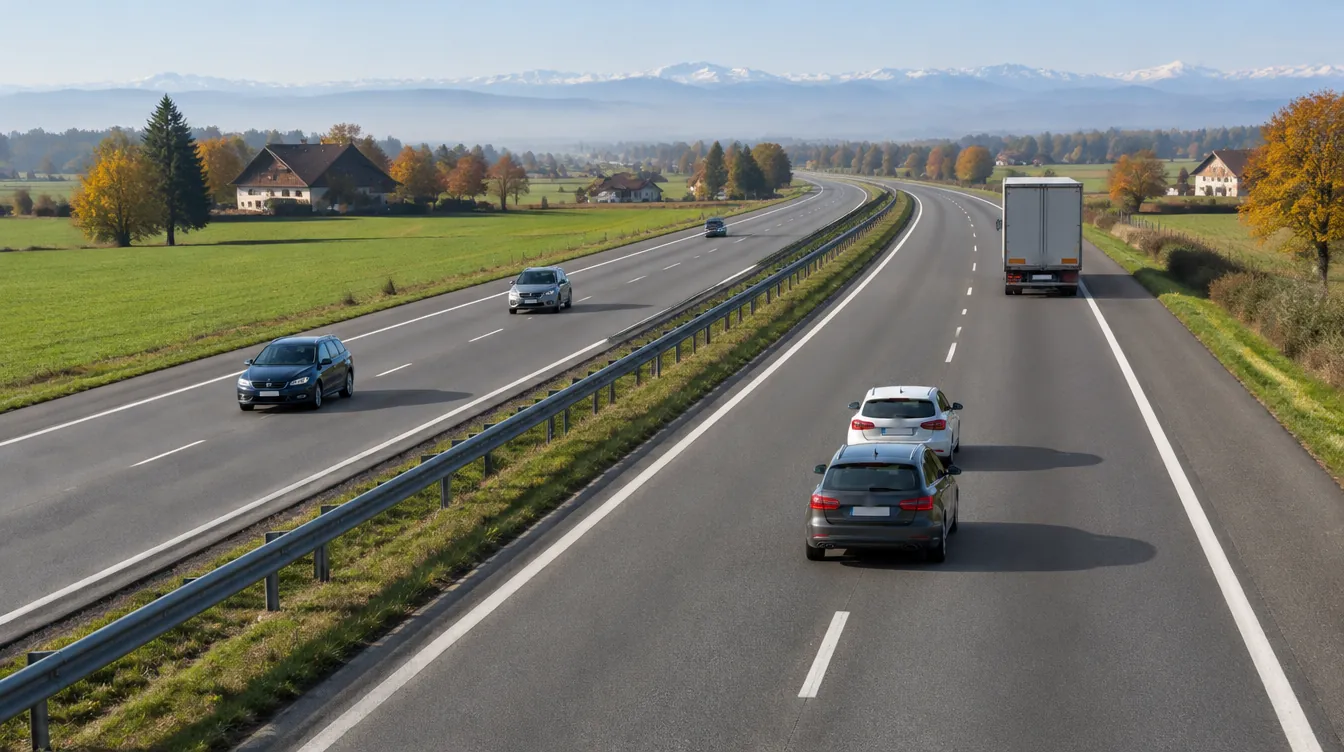
No. The safety line (German: Sicherheitslinie, French: ligne de sécurité) is the continuous white line in the middle of the road or between two lanes (marking 6.01). Vehicles may neither drive over it nor cross it (Art. 73 para. 6 let. a SSV). On roads with a safety line you must always drive to the right of it (Art. 34 para. 2 SVG). This applies not only to overtaking, but also to turning left into a driveway, making a U-turn and cutting a bend.
- Inside built-up areas: fixed fine of CHF 140 by car or motorbike, CHF 40 by bicycle, e-bike or moped (OBV Annex 1 no. 341 and 618).
- Outside built-up areas and on motorways: no fixed fine but a police report. Criminal proceedings follow, and the road traffic office decides on a warning or a licence withdrawal.
- If you endanger others (for example overtaking before a crest): medium or serious offence depending on the danger, withdrawal of at least one or three months.
How to overtake correctly is covered in Overtaking in Switzerland. This article is about the line itself: which variants exist, which exceptions the law allows and what a violation costs inside and outside built-up areas and during the probationary period.
What is a safety line?
The Swiss Signalling Ordinance (SSV) describes it plainly: safety lines are white and continuous and mark the centre of the carriageway or lane boundaries. They are also used to separate the carriageway or lanes from tram tracks (Art. 73 para. 1 SSV).
They are painted where crossing the centre would be dangerous: before crests, in blind bends, before junctions, at pedestrian islands or on stretches with poor visibility. Since 1 July 2026 the SSV expressly states that safety lines may be no longer than visibility and usual speed require. At the same time, minimum lengths apply: 20 m inside and 50 m outside built-up areas (Art. 73 para. 1bis SSV). A solid line is never decoration; it is placed on purpose.
Important for the theory test: the safety line is a road marking. Markings are binding like signs and take precedence over the general traffic rules (Art. 27 para. 1 SVG). "Nobody was coming" is therefore no excuse.
The lines compared: 6.01 to 6.05
In the exam and on the road you need to tell five white longitudinal lines apart (Art. 73 para. 1–6 SSV):
- Safety line (6.01): one continuous line. Must not be driven over or crossed from either side.
- Double safety line (6.02): two parallel continuous lines. It separates the directions of travel on carriageways with at least three lanes or where special safety needs require it (para. 2). Same rule as 6.01: off limits.
- Guide line (6.03): broken line. May be crossed with due care.
- Double line (6.04): a safety line next to a guide line. What matters is the side you are on: if the continuous line is on your side, you may not cross. If the broken line is on your side, you may cross it with care (para. 4 and para. 6 let. c). Typical where only one direction has too little visibility.
- Warning line (6.05): broken line with longer dashes and shorter gaps. It announces a safety line or double line. Outside built-up areas it must be painted, inside it may be painted (para. 5). When you see the warning line, finish any overtaking manoeuvre and do not start a new one.
Rule of thumb: continuous on my side means "do not cross". Broken on my side means "cross only with care".
Exceptions: when may the line be crossed?
The law knows only a few, precisely defined exceptions. Everything else is a violation.
- Short broken line alongside (white): where a short broken section is painted parallel to the safety line, vehicles on the side of the broken line may cross the safety line at that point, for instance to turn into a driveway or car park (Art. 73 para. 7 SSV).
- Short broken line in yellow: applies only to public-service buses, cyclists and moped riders. Car drivers may not cross there (Art. 73 para. 7 SSV).
- Double line from the broken side: see above (6.04).
- Police instructions: they override all signs and markings (Art. 27 para. 1 SVG). If the police wave you across the line at an accident scene, you may follow.
- Yellow-orange in-road lights: when switched on, they cancel the white markings. They are used on motorways and expressways to guide traffic across the central reserve, for example before tunnels (Art. 72b SSV).
Not an exception: a slow tractor, a cyclist ahead of you, a driveway on the other side without a break in the line, or "perfect visibility". If you want to turn left into a driveway but the safety line is continuous, drive on and turn round at a suitable place, for example at the next roundabout.
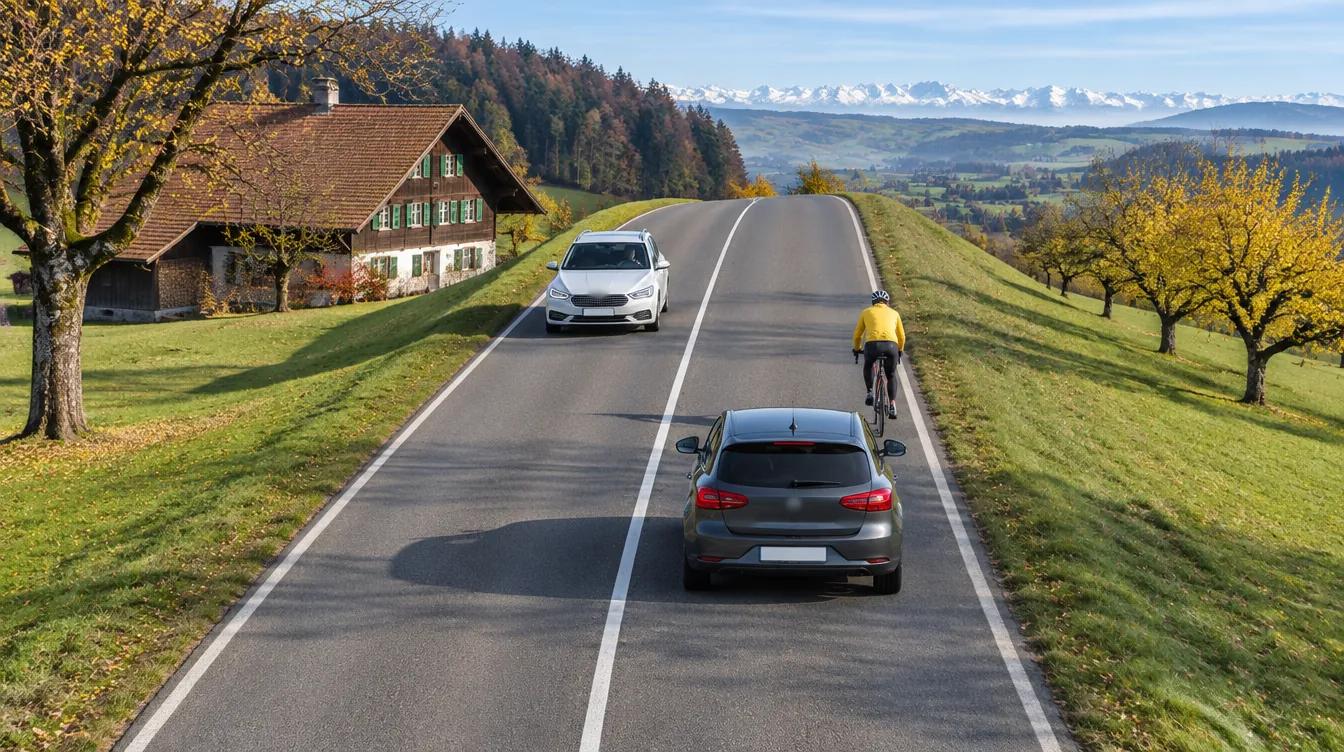
Overtaking a cyclist despite a safety line?
One of the most common questions. The answer has two parts:
- Allowed: you may overtake a cyclist or moped rider if you stay to the right of the safety line. You may then even overtake in bends and before crests, provided users of your half of the road are not hindered (Art. 11 para. 3 VRV).
- Not allowed: if there is only room by moving onto or over the line, stay behind the cyclist. Sufficient distance must be kept from all road users, in particular when overtaking (Art. 34 para. 4 SVG). Squeezing past without distance just to avoid touching the line is also wrong.
How much lateral distance you need and how to judge gaps is explained in Safe distance in Switzerland.
Safety lines on motorways and between lanes
Safety lines are not only found in the middle of the road. They also separate lanes in the same direction, for example before junctions with lane arrows or at motorway entries and exits.
- Lane selection zones: if you do not continue in the direction of your lane arrow and drive over a safety line between lanes in the same direction, the fixed fine is CHF 100 (OBV Annex 1 no. 306.3). Remember: wrong lane? Drive on, do not cut across.
- Acceleration lane: if the lane to your left is separated by a safety line or by the continuous side of a double line, you may pass other vehicles on the right with due care until the end of that marking (Art. 36 para. 5 let. c VRV). Vehicles on the motorway still have priority (Art. 36 para. 4 VRV).
- Exits: deceleration lanes are usually separated from the through lanes by a double line (Art. 90 para. 2 SSV). If you have missed the exit, carry on to the next one without crossing the line or the hatched restricted area (6.20). Restricted areas must not be driven on (Art. 78 SSV).
Apart from lane selection (no. 306.3), there is a fixed fine for the safety line only inside built-up areas. On motorways and outside built-up areas, crossing it is therefore reported rather than settled with a ticket.
Fines inside built-up areas
Inside built-up areas there are fixed fines, provided nobody was endangered:
- Driving over or crossing a safety line inside a built-up area, car or motorbike: CHF 140 (OBV Annex 1 no. 341)
- The same by bicycle, e-bike or moped: CHF 40 (no. 618)
- Driving over or crossing a hatched restricted area inside a built-up area: CHF 140 (no. 342)
- Passing a traffic island or restricted area on the left: CHF 100 (no. 343, Art. 7 VRV)
- Parking next to a safety line without leaving a 3 m wide passage: CHF 120 (up to 60 minutes), stopping CHF 80 (no. 208, Art. 18 para. 2 let. c VRV)
The fixed-fine procedure is a simplified procedure. It is excluded if you endangered or injured someone or caused damage, or if further offences not listed in the catalogue are added (Art. 4 para. 3 OBG). Several fixed fines are added up; above CHF 600 ordinary proceedings apply (Art. 5 OBG).
Outside built-up areas: report, fine and licence withdrawal
Crossing the safety line outside built-up areas is not listed in the fixed-fine catalogue. That has two consequences:
- Criminal proceedings: the police report you. The public prosecutor or the competent authority sets the fine under Art. 90 para. 1 SVG case by case. There is no fixed tariff, and procedural costs come on top. In case of serious danger, such as overtaking over the safety line before a crest or a blind bend, a conviction for gross violation of traffic rules is possible, with a monetary penalty or up to three years' custody (Art. 90 para. 2 SVG). Reckless overtaking with a high accident risk can even fall under Art. 90 para. 3 SVG.
- Administrative measure: where the fixed-fine procedure is excluded, the licence is withdrawn or a warning is issued (Art. 16 para. 2 SVG). Only in particularly minor cases is no measure taken (Art. 16a para. 4 SVG).
The levels at a glance:
- Minor offence (slight danger, slight fault): warning; withdrawal of at least one month if a measure was imposed in the previous two years (Art. 16a SVG).
- Medium offence (danger caused or accepted): withdrawal of at least one month (Art. 16b SVG).
- Serious offence (gross violation, serious danger): withdrawal of at least three months (Art. 16c SVG); for reckless overtaking with a high accident risk at least two years (Art. 16c para. 2 let. abis SVG).
Which level applies depends on the concrete danger: visibility, oncoming traffic, speed and how long you were on the opposite side. How withdrawal periods work together is explained in Licence withdrawal in Switzerland.
New drivers: the safety line during probation
For holders of a probationary licence, a solid line is particularly expensive. If the licence is withdrawn for a medium or serious offence, the probationary period is extended by one year (Art. 15a para. 3 SVG). A second medium or serious offence during probation makes the licence lapse. You then need a traffic-psychology assessment, can get a new learner's permit at the earliest after one year and must pass the test again (Art. 15a para. 4–6 SVG). A risky overtaking manoeuvre across the safety line can therefore mean starting over. Details on probation: Probationary driving licence.
Typical exam traps
- "Nobody is coming": irrelevant. The line always applies, also at night and on an empty road.
- Double line: what counts is the line on your side. Continuous means no, broken means yes, with care.
- Missing the warning line: the longer dashes announce the safety line. Starting an overtake here leaves no time to get back.
- Turning left into a driveway: only allowed where a short white broken line is painted on your side.
- Yellow break: only for public-service buses, cyclists and moped riders.
- Overtaking a cyclist right of the line: allowed, even in a bend, if enough distance remains and nobody on your half is hindered.
- Parking: next to a safety line only if at least 3 m of passage remain. More in Stopping and parking.
How to practise road markings for the theory test
Marking questions are picture questions: you see a road from the driver's view and must decide whether a manoeuvre is allowed. Learn the five lines as pairs (continuous versus broken), then practise situations with oncoming traffic, cyclists and driveways. Start with the free online theory test or the demo. For all official question areas, unlock 60 days of access on the pricing page or order directly.
FAQ
What does crossing the safety line cost?
Inside built-up areas a CHF 140 fixed fine by car (OBV no. 341), CHF 40 by bicycle or moped (no. 618). Outside built-up areas and on motorways there is no fixed fine but a report with a case-by-case fine and administrative proceedings.
Can you lose your licence for crossing the safety line?
Inside built-up areas without endangering anyone, no: the fixed fine settles it. Outside built-up areas a warning or withdrawal is ordered; once others are endangered it is at least one month, with serious danger at least three months.
May I turn left across a double safety line?
No. Double safety lines, like single ones, must not be driven over or crossed. Drive on and turn round where it is allowed.
May I cross the safety line to get round an obstacle?
The law has no general exception for this. Stop, wait until the situation clears, or follow police instructions.
What is the difference between a safety line and a double line?
The safety line is off limits from both sides. The double line combines a safety line and a guide line: only drivers on the side of the broken line may cross.
Sources
- Road Traffic Act (SVG, SR 741.01): Art. 15a para. 3–6, Art. 16 para. 2, Art. 16a–16c, Art. 27 para. 1, Art. 34 para. 2 and 4, Art. 90 para. 1–3
- Signalling Ordinance (SSV, SR 741.21): Art. 72b, 73, 74, 78, 90 para. 2; Annex 2 (markings 6.01–6.05, 6.20)
- Traffic Rules Ordinance (VRV, SR 741.11): Art. 7, 11 para. 3, 18 para. 2 let. c, 36 para. 4 and 5
- Fixed Fines Act (OBG, SR 314.1): Art. 4 para. 3, Art. 5
- Fixed Fines Ordinance (OBV, SR 314.11): Annex 1 no. 208, 306.3, 341, 342, 343 and 618
Note: not legal advice; the laws in force and the individual case are decisive. Official names are German/French/Italian; English names here are translations.
Start free demo · Learn online for free · Unlock 60 days · Order