Mountain road priority in Switzerland: uphill, downhill & theory exam
Mountain road priority in Switzerland for the theory exam: who has right of way uphill or downhill, when to pull aside, pull-outs and typical traps – clear and practise-ready.
Short answer — who has priority on a mountain road?
For mountain road priority (Vortritt Bergstrasse) in Switzerland, the theory exam mainly tests situational judgement: Do you recognise the narrow stretch, the gradient and who must pull aside? This short answer is for skimming – the sections below cover rules, pull-outs and typical traps.
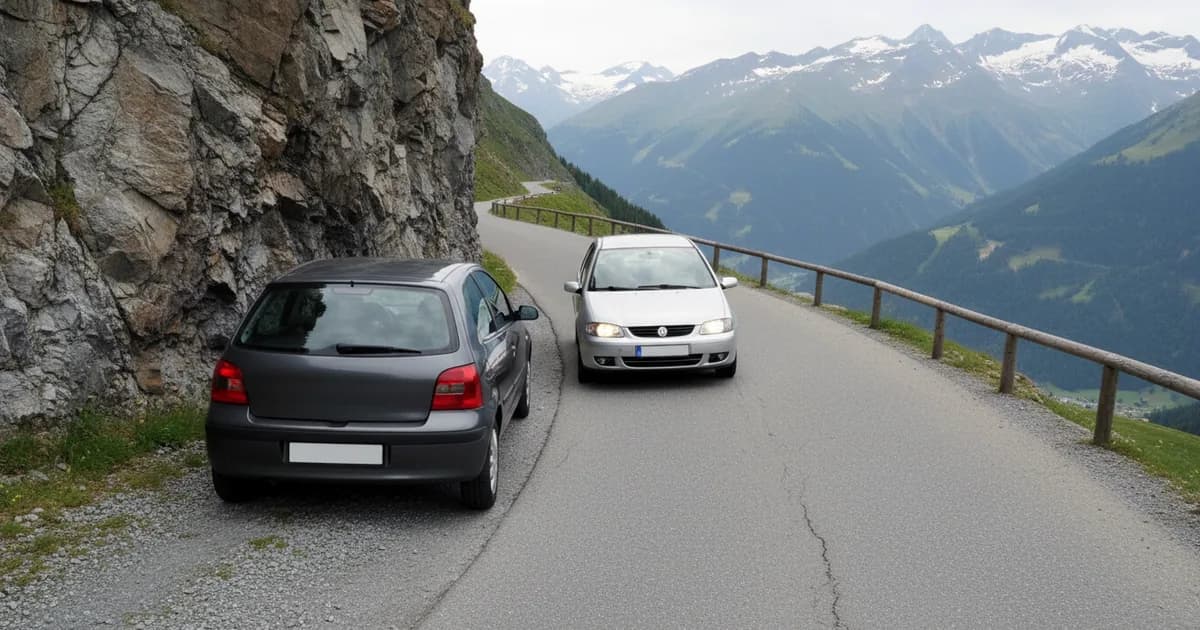
- Uphill has priority: On a narrow or single-track mountain road where passing is difficult, the vehicle going uphill typically has right of way.
- Downhill yields: The vehicle going downhill looks for a suitable pull-out (Ausweichstelle) and clears the way for the uphill vehicle.
- Not “I was there first”: Arrival order does not replace the mountain rule when the picture clearly shows uphill/downhill and a pinch point.
- Right-hand traffic (RHT): All examples assume Swiss right-hand traffic – no left-hand-traffic framing.
Rules hub: Swiss traffic rules. Broader right-of-way system (right-before-left, roundabouts, pedestrians, tram): Right of way Switzerland – theory exam.
What counts as a mountain road in the theory exam?
In the exam, “mountain road” is rarely a word game about signs – it is a situation picture: visible ascent or descent, often narrow, sometimes with pull-out bays. You read gradient + space + oncoming traffic, not only the keyword “mountain”.
Exam-wise the picture language is often enough: slope direction, a short sight line behind a bend, an oncoming vehicle that “fills” the space. Anyone who only looks for a sign misses the real question – namely uphill priority vs yielding downhill. That is how this deep-dive differs from the short mountain paragraph in the Vortritt overview: here you truly train the pinch point.
Narrow / single-track vs wider road with pull-out bays
- Narrow / single-track: Passing without pulling aside is barely possible – the mountain rule is especially clear: uphill priority, downhill seeks space.
- Wider with pull-out bays: The logic stays: downhill uses the visible pull-out; uphill should not have to stop and restart unnecessarily.
- Wide, easy pass road: If two vehicles can pass safely, “forcing mountain priority” is often the wrong reading – the exam rewards safe passing, not keyword reflexes.
Mnemonic: the narrower and steeper the picture, the more the uphill/downhill logic matters. On a clearly marked, wide carriageway with two safe lanes, “mountain” alone is not a free pass to take the road from oncoming traffic – the exam rewards the matching pattern, not the loudest keyword.
If you are unsure whether the road is “narrow enough”, ask whether passing without stopping or manoeuvring looks realistic. If not – then the mountain rule is the safe frame for a narrow mountain road and a single-track mountain road.
Situation pictures — gradient, oncoming traffic, pull-out
Exam-wise, scan in two seconds:
- Ascent / descent: Who is going uphill, who downhill?
- Space: Pinch point, bend, sight – can both continue?
- Pull-out: Bay, widening, safe verge – closer to whom?
- Vehicle type: Bus, trailer, motorcycle – harder restart or sight?
Think speed and gap: Speed limits in Switzerland and Following distance in Switzerland.
Uphill has priority — the basic rule
The exam-near core rule for uphill priority: On mountain roads where pulling aside is difficult, the uphill vehicle has right of way. The downhill vehicle yields. Train it that way for picture questions – without invented CHF fines and without a physics essay.
Phrase it as a checklist: (1) Is oncoming traffic visible? (2) Is passing without pulling aside difficult? (3) Who is going uphill? If yes–yes–uphill, you have the core of who has priority on a mountain road. Everything else (pull-out, closeness, vehicle type) refines the action but rarely changes the principle.
Why uphill — exam framing
- Restarting on a slope: Moving off uphill is harder (especially with a trailer, bus or wet surface). So uphill should preferably keep rolling.
- Safety before haste: Downhill can reduce speed in a controlled way and aim for a place to wait – that is the expected sequence in exam logic.
- Picture before gut feel: “I was almost through” or “the other is still far” does not replace the mountain rule when oncoming traffic and a pinch point are clear.
- No invented special rules: No home-made exceptions like “only above 10% gradient” or “only with a trailer” – the exam shows slope and pinch point; you apply mountain logic.
In real alpine passes, operators or cantons may add extra guidance – for basic theory what counts is the pictured gradient and the visible pinch point. Note: Exam prep in typical syllabus logic (SVG/ASTRA framing), not legal advice and not a substitute for official guidance.
Downhill: reduce speed + find a pull-out
If you are going downhill and see oncoming traffic:
- reduce speed early – do not brake only in the pinch point;
- aim for a suitable pull-out (bay, widening, safe edge);
- clear the way for the uphill vehicle without forcing them to reverse far down the slope;
- with poor sight (bend, weather), look for space even earlier instead of “pushing through”.
Overtaking on a mountain road is a separate topic and often risky – short link: Overtaking in Switzerland.
Pull-out (Ausweichstelle) — who yields when?
The pull-out is the practical pivot of many mountain questions: not only “who has priority”, but “where can you meet safely?”. Many candidates know the slogan “uphill has priority” – and still fail because they do not “think” the next bay. Priority without a yield plan is often only half an answer in the exam.
Treat the pull-out as a workplace: visible, wide enough for your vehicle, with sight of oncoming traffic, without unnecessary manoeuvring into the bend. If it is behind you, plan early – not only when oncoming traffic is already in the pinch point.
Pull-out closer to whom?
- Closer to the downhill vehicle: Typically downhill waits there and lets uphill through.
- Closer to the uphill vehicle: Exam-wise it can be expected that uphill reverses briefly to the pull-out – so downhill need not reverse far downhill. Read the picture: distance, sight, vehicle length.
- Both have a bay: Downhill remains the primary “yield actor”; uphill holds the line once safe passing becomes possible.
Mnemonic: uphill priority does not mean “uphill never manoeuvres” – it means uphill should not lose the harder restart advantage without need, and downhill actively seeks space.
Trap “I was there first” vs the mountain rule
Classic theory traps:
- Wrong: “I entered the pinch point first, so I have priority” – against clear uphill oncoming traffic.
- Wrong: Downhill “squeezing through” although a pull-out was reachable.
- Right: Read the picture – gradient, pinch point, pull-out – then apply the mountain rule.
The same “I was first” trap appears with right-before-left at junctions; details in the overview Right of way in Switzerland.
Mountain roads and general right-of-way rules
Important boundary: the mountain rule mainly covers meeting on the mountain road (oncoming traffic, pinch point). It does not replace the whole priority system. That is why this article stays lean on right-before-left, roundabouts, pedestrians and tram – and deliberately links to the overview. You should gain mountain depth without cannibalising two Vortritt articles against each other.
Junction on a mountain → right-before-left / signals (short)
If you meet a junction or side road on the mountain, signals and general priority rules come first – typically right-before-left unless something else is signed. Uphill/downhill logic does not automatically override every junction. A classic misunderstanding: “I am going uphill, so I have priority at every side road.” Exam-wise wrong – read signals and right-before-left first, then mountain patterns only if the picture shows meeting traffic on the stretch. Signs: Swiss traffic signs; lights: Swiss traffic lights.
Do not rewrite the full priority system here
Right-before-left, roundabouts, zebra crossings, tram – that stays in the system article. This deep-dive owns uphill, downhill and pull-outs. Other special places only as links, e.g. Zebra crossings in Switzerland.
Oncoming traffic, columns, bike/motorcycle on the mountain
Practical and exam-focused:
- Oncoming traffic: spot early, adapt speed, plan a pull-out – do not decide only “bumper to bumper”.
- Uphill column: keep distance, do not push; downhill yielding needs visible intent and space. See following distance.
- Bicycle: slow, often wide or tight depending on the bend – as a driver think space and speed; as a cyclist do not read “mountain priority” as a free pass for risky lines.
- Motorcycle / moped: same mountain logic; sight line and stopping distance on a slope are more critical. Practise: Motorcycle theory course.
- Bus / trailer: harder uphill restart and manoeuvring – in the picture, yield especially carefully.
- Night / weather / wet: sight and stopping distance get tighter – downhill take speed off even earlier and seek space instead of “almost squeezing through”.
In short: the same mountain principles, but with more safety margin. Anyone who sees “only the priority question” on the mountain and forgets speed/distance builds exactly the errors simulations reward you for avoiding.
Typical theory traps
No copyrighted exam dumps and no copied tasks – only rule explanations for who has priority on a mountain road. Use the list as a training check: read each trap once aloud with the picture in mind (gradient, pinch point, pull-out), then you decide calmer under time pressure.
- “Who has priority uphill or downhill?” – Typically uphill when the road is narrow / passing is hard; downhill yields.
- “I was first in the pinch point – does that count?” – Not as a substitute for the mountain rule on a clear uphill/downhill picture.
- “Narrow single-track mountain road – what to do downhill?” – Slow early, find a pull-out, let uphill through.
- “Pull-out closer to uphill – must uphill reverse?” – Often yes exam-wise if that is the safe, sensible move; read picture and distance.
- “Junction on the mountain – always mountain priority?” – No; at junctions signals / right-before-left first (system: right of way).
- “Wide pass road, easy to pass – still force the mountain rule?” – If passing is clearly possible, safe passing counts; do not apply the keyword “mountain” without a pinch point.
How to practise priority & mountain roads online for free
Many errors happen because “mountain” is treated as a keyword instead of a picture. Practice goal: stable pattern recognition – not memorising wording. Take two seconds in the simulation:
- Clear ascent / descent? – who uphill, who downhill?
- Pinch point / sight? – can both continue?
- Pull-out? – closer to whom?
- Junction / signal? – then general priority logic first.
- Heavy vehicle / trailer? – think uphill restart.
Practise:
- Start with the demo.
- Mixed sets on learn the theory test online free.
- Full simulations via learn driving theory or motorcycle on Motorcycle theory course.
- Light upsell if needed: pricing.
Note: Details can vary by canton. When in doubt, ask your road traffic office – this article does not replace official guidance.
FAQ
Who has priority uphill or downhill?
On a narrow mountain road where passing is hard, typically uphill; downhill yields at a suitable place. Rules overview: Swiss traffic rules.
What applies on a narrow mountain road?
Read the mountain rule: uphill priority, downhill seeks a pull-out; adapt speed and sight early. System context: Right of way in Switzerland.
Who must pull aside?
Usually the downhill vehicle – at the next suitable pull-out. If the place is clearly closer to uphill, uphill may reverse briefly to the bay.
Does the mountain rule also apply at junctions?
Not automatically: at junctions and side roads, signals and general priority rules apply (e.g. right-before-left). The mountain rule mainly covers oncoming traffic on the mountain road itself.
Ready to solve mountain-road priority calmly?
Read pinch point and gradient, apply uphill priority, seek a pull-out downhill, do not put “I was first” against the mountain rule, separate junctions from meeting traffic – that is the exam core for mountain road priority in Switzerland. Pair with Swiss traffic rules, right of way, speed and distance, and practise pictures. Stable judgement under time pressure cuts error points – whether the next simulation is car, motorcycle or moped.