30 km/h zone in Switzerland: priority, pedestrians & fines
30 km/h zones in Switzerland: priority to the right, pedestrians without zebra crossings, shared zones at 20 km/h, where the zone ends and the fines for speeding.
Short answer: what applies in a 30 km/h zone?
A 30 km/h zone (Tempo-30-Zone) in Switzerland is a signposted zone in residential areas or neighbourhoods. You must drive with particular care and consideration, and the maximum speed is 30 km/h (Art. 22a SSV). The key points at a glance:
- Speed: 30 km/h from the zone sign (2.59.1) to the end-of-zone sign (2.59.2), on every street in the zone.
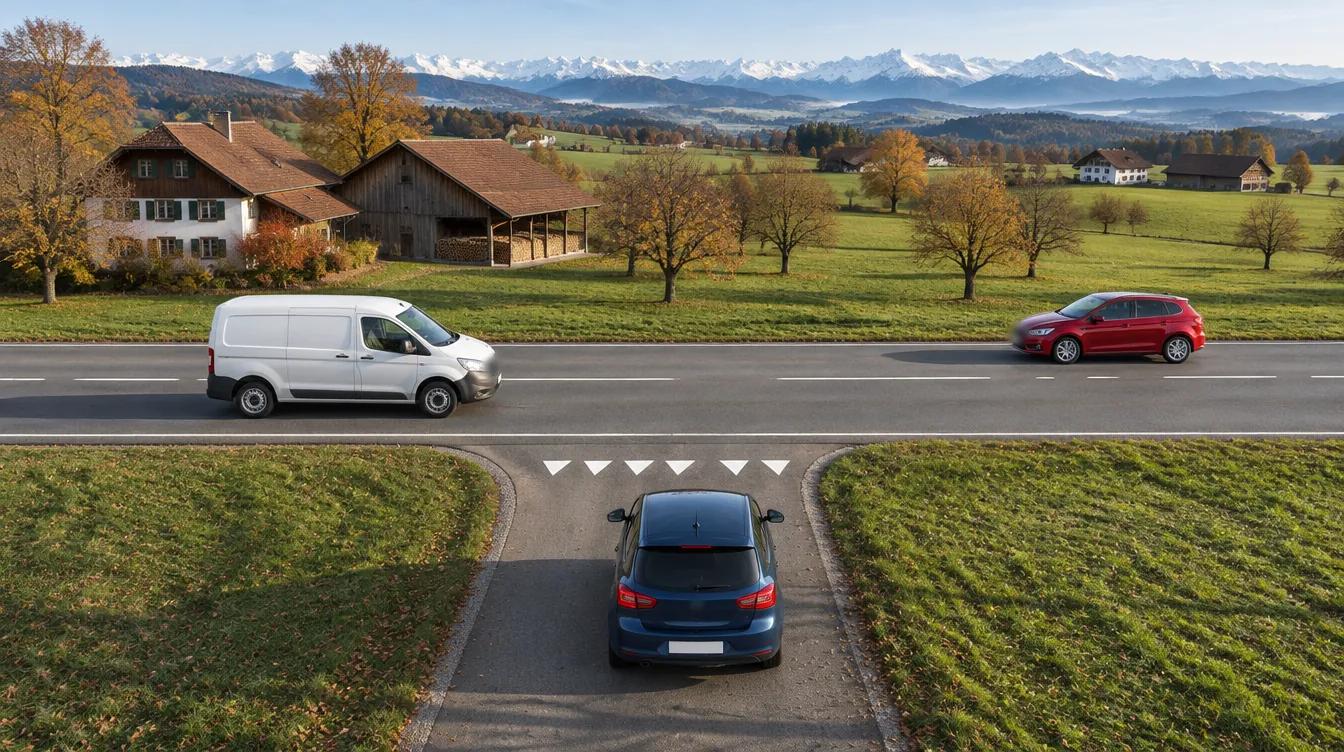
- Priority: As a rule, priority to the right applies. Other priority rules with signs are only allowed as an exception.
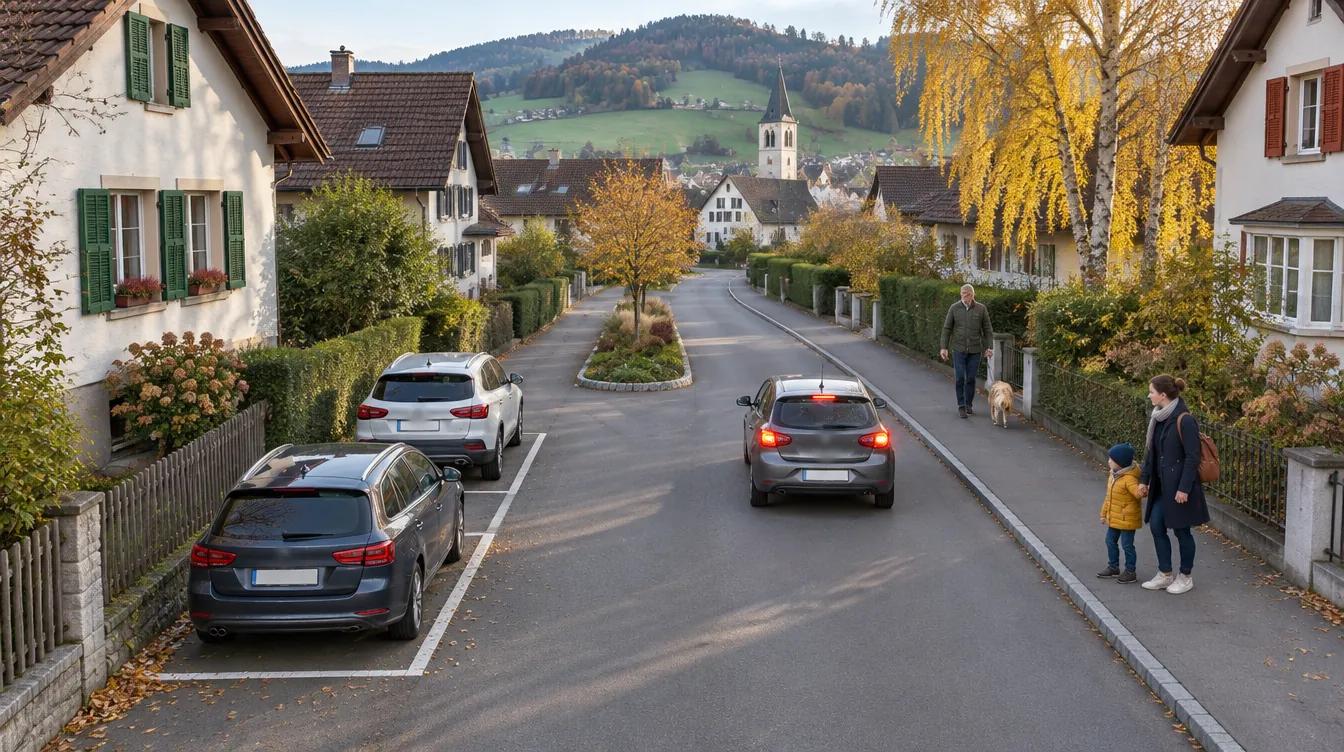
- Pedestrians: Zebra crossings exist only as an exception, for example near schools and care homes. Without a crossing, pedestrians do not have priority, but you must let them cross in a reasonable way.
- Shared zone (Begegnungszone): Here the limit is 20 km/h; pedestrians may use the whole area and have priority (Art. 22b SSV).
- Fines: Speeding in the zone costs CHF 40 to 250 as a fixed penalty; above that you are reported.
General speed limits are explained in speed limits in Switzerland. This article is only about the zones in residential areas.
What is a 30 km/h zone?
The “30 km/h zone” sign (2.59.1) marks streets in residential areas or neighbourhoods where drivers must drive with particular care and consideration (Art. 22a SSV). These principles apply:
- Built-up areas only: Zone signs are only allowed on roads inside built-up areas (Art. 2a para. 2 SSV).
- From start to end: The rules apply from the zone sign to the end-of-zone sign. After that, the general traffic rules apply again (Art. 2a para. 3 SSV), so in town usually 50 km/h.
- Residential streets: 30 km/h zones are generally only allowed on secondary roads that do not carry through traffic (Art. 2a para. 5 SSV). A section of a main traffic road with a signposted 30 km/h limit may be included in the zone (Art. 2a para. 6 SSV).
- Clearly recognisable: Zone entrances and exits are designed to look like a gate. You often also see narrowings, trees or other traffic-calming elements (Art. 5 of the Ordinance on 30 km/h zones and shared zones).
Important for the exam: the zone does not end at the next junction, only at the end-of-zone sign. What zone and end-of-zone signs look like is shown in regulatory signs in Switzerland.
Priority in a 30 km/h zone: priority to the right
At junctions, the vehicle coming from the right has priority (Art. 36 para. 2 SVG). In 30 km/h zones this is the normal case: a priority rule that differs from priority to the right may only be set by signs if road safety requires it or if the priority road is part of a defined cycle route network (Art. 4 para. 1 of the Ordinance on 30 km/h zones and shared zones).
In practice: at every side street, expect someone coming from the right and drive so that you can stop in time. If a priority sign is present, it takes precedence over priority to the right. Practise the basics with priority rules for the theory exam.
Do pedestrians have priority in a 30 km/h zone?
This is the most common question about 30 km/h zones. The answer depends on whether there is a zebra crossing:
- Usually no zebra crossing: Zebra crossings are not allowed in zones. In 30 km/h zones they may be installed where pedestrians have special priority needs, in particular near schools and care homes (Art. 4 para. 2 of the Ordinance).
- Without a crossing: Pedestrians may cross the road, but must give way to vehicles (Art. 47 para. 5 VRV). As a driver you must let them cross in a reasonable way (Art. 33 para. 1 SVG) and drive with particular consideration in the zone (Art. 22a SSV).
- In queuing traffic: On roads without a zebra crossing you must stop if necessary when pedestrians are waiting to cross (Art. 6 para. 3 VRV).
- With a zebra crossing: The normal rule applies: anyone on the crossing, or waiting in front of it and clearly wanting to cross, has priority (Art. 6 para. 1 VRV).
In short: in a 30 km/h zone there is no automatic pedestrian priority like at a zebra crossing, but there is a clear duty of consideration. Children in particular decide spontaneously. All rules at crossings are in zebra crossings in Switzerland.
Shared zone: 20 km/h and pedestrians with priority
The shared zone (sign 2.59.5, end 2.59.6) is the even calmer variant. It marks streets in residential or shopping areas (Art. 22b SSV):
- Pedestrians and users of vehicle-like devices (for example kick scooters or inline skates) may use the whole traffic area.
- They have priority over drivers, but must not hinder vehicles unnecessarily.
- The maximum speed is 20 km/h.
- Parking is only allowed in places marked by signs or road markings. Bicycles and mopeds follow the general parking rules.
- No zebra crossings: They are not allowed in shared zones, because pedestrians have priority everywhere anyway.
How to read parking bays and markings is explained in stopping and parking in Switzerland. For the parking disc see blue zone in Switzerland.
30 km/h zone, shared zone, pedestrian zone compared
- 30 km/h zone (2.59.1): 30 km/h, priority to the right as the rule, pedestrians without a crossing have no priority, drivers must show particular consideration (Art. 22a SSV).
- Shared zone (2.59.5): 20 km/h, pedestrians may use the whole area and have priority, parking only in marked bays (Art. 22b SSV).
- Pedestrian zone (2.59.3): reserved for pedestrians. If vehicles are exceptionally allowed, they may drive at walking pace at most and pedestrians have priority (Art. 22c SSV).
If a 30 km/h zone is directly followed by a shared zone, or the other way round, the new zone sign also marks the end of the previous zone (Art. 2a para. 3bis SSV, in force since 1 July 2026). No separate end sign is needed.
Fines: how much does speeding in a 30 km/h zone cost?
In 30 km/h zones and shared zones the fixed penalties for built-up areas apply. What counts is the excess speed after deducting the device and measurement tolerance set by FEDRO (OBV Annex 1 no. 303.1):
- 1 to 5 km/h too fast: CHF 40
- 6 to 10 km/h too fast: CHF 120
- 11 to 15 km/h too fast: CHF 250
- More than 15 km/h: no fixed penalty any more, but a report with possible administrative measures.
- Reckless speeding offence: from at least 40 km/h over where the limit is 30 km/h or less (Art. 90 para. 4 let. a SVG).
Parking in a shared zone outside marked places costs CHF 40 up to 2 hours, CHF 60 up to 4 hours and CHF 100 up to 10 hours (OBV Annex 1 no. 251). Worked examples such as “caught at 50 in a 30 zone” are in speeding fines in Switzerland, and the consequences for your licence in licence withdrawal in Switzerland.
Typical exam traps
- Forgetting the zone: You turn into a residential street and think of 50 km/h. The zone applies until the end-of-zone sign, even after several junctions.
- “Pedestrians always have priority”: That is true in shared zones and at zebra crossings, not automatically everywhere in a 30 km/h zone. Consideration is still mandatory.
- Missing priority to the right: A vehicle coming from a small side street on the right has priority unless a sign says otherwise.
- Mixing up 20 and 30: shared zone 20 km/h, 30 km/h zone 30 km/h, pedestrian zone walking pace.
- Parking in a shared zone: Only in marked or signposted places, not simply at the edge of the road.
How to practise zones for the theory exam
Zones often appear in the exam as picture questions: which speed applies here, who has priority, may I park here? Start with the free demo or learn without signing up at learn online for free. Plan your weeks with the study plan and read how many questions the theory exam has. Unlock all questions on the pricing page or go straight to order.
FAQ
Do pedestrians have priority in a 30 km/h zone?
Only on a zebra crossing (Art. 6 para. 1 VRV). Without a crossing, pedestrians must give way to vehicles (Art. 47 para. 5 VRV), but drivers must let them cross in a reasonable way (Art. 33 para. 1 SVG).
Are there zebra crossings in 30 km/h zones?
Generally not. They are only allowed where pedestrians have special priority needs, in particular near schools and care homes (Art. 4 para. 2 of the Ordinance on 30 km/h zones and shared zones).
Does priority to the right always apply in a 30 km/h zone?
It is the rule. Different priority signs are only allowed if road safety requires it or the road belongs to a defined cycle route network (Art. 4 para. 1 of the Ordinance).
How fast may I drive in a shared zone?
At most 20 km/h. Pedestrians have priority there (Art. 22b SSV).
Where does a 30 km/h zone end?
At the end-of-zone sign (2.59.2) or, if a shared zone follows directly, at its zone sign (Art. 2a para. 3 and 3bis SSV).
How much does 10 km/h over in a 30 km/h zone cost?
A net excess of 6 to 10 km/h in a built-up area costs CHF 120 (OBV Annex 1 no. 303.1 let. b).
Sources
- Signalisation Ordinance (SSV, SR 741.21, as of 1 October 2026): Art. 2a, 22a, 22b, 22c; Annex 2 signs 2.59.1 to 2.59.6
- DETEC Ordinance on 30 km/h zones and shared zones (SR 741.213.3, as of 1 October 2026): Art. 4, 5
- Road Traffic Act (SVG, SR 741.01): Art. 33, 36 para. 2, 90 para. 4
- Traffic Rules Ordinance (VRV, SR 741.11): Art. 6, 47
- Fixed Penalties Ordinance (OBV, SR 314.11, as of 1 August 2026): Annex 1 no. 251 and 303.1
Note: Not legal advice. The laws in force, the signs on site and the individual case are what count.
Start the free demo · Learn online for free · Unlock 60 days · Order