Zebra crossings in Switzerland: stop duty & rules for the theory exam
Zebra crossings in Switzerland for the theory exam: stop duty at the Fussgängerstreifen, pedestrian priority, columns, bike traps and Zone 30 / encounter zones – typical traps and how to practise.
Short answer — when must you stop at a zebra crossing?
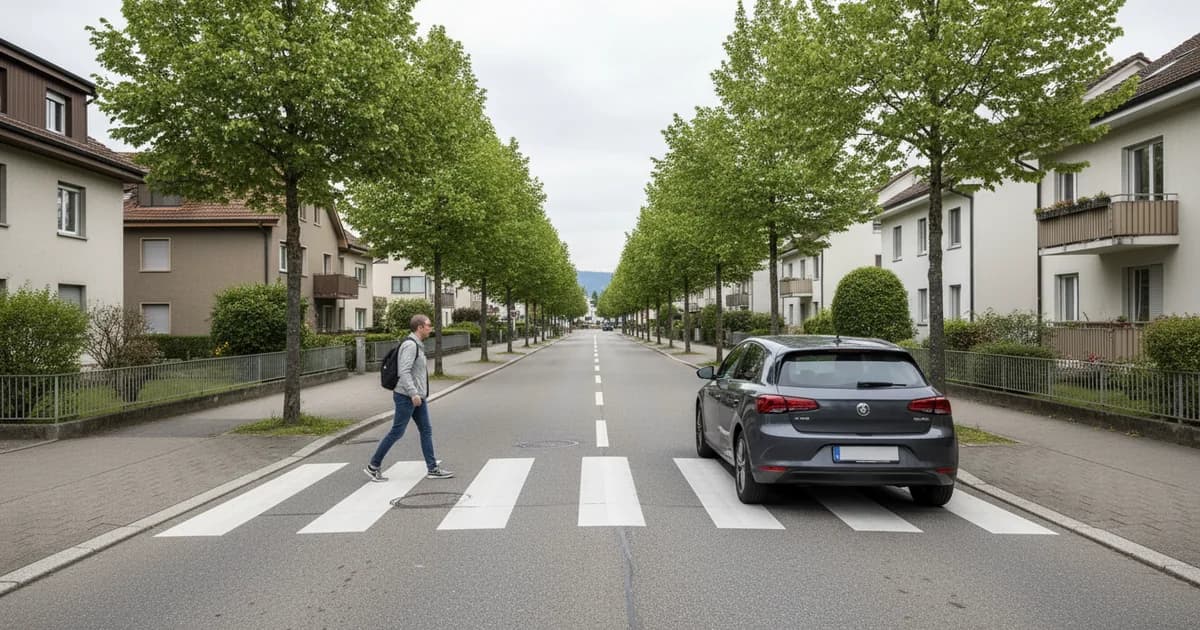
For zebra crossings in Switzerland, the theory exam mainly tests situational judgement: Do you recognise the pedestrian crossing (Fussgängerstreifen), the pedestrians’ intent and your duty to stop (Haltepflicht)? This short answer is for skimming – the sections below cover rules, traps and how to practise.
- Duty to stop: You must stop when pedestrians are crossing, waiting to cross or clearly approaching to cross – and you must not endanger or obstruct them.
- Naming: Officially often Fussgängerstreifen; colloquially Zebrastreifen – the exam rewards reading the scene, not the nickname.
- Multi-lane / column: Even if the neighbouring lane keeps moving: if you must clear the crossing, you stop – do not force pedestrians between lanes.
- Right-hand traffic (RHT): All examples here assume Swiss right-hand traffic – no left-hand-traffic framing.
Rules hub: Swiss traffic rules. Broader right-of-way system: Right of way in Switzerland.
What is a zebra crossing (Fussgängerstreifen) in Switzerland?
A Fussgängerstreifen is the marked crossing where pedestrians should cross the carriageway with special protection – and where your duty to stop applies. The exam often shows pictures: stripes, pedestrians at the kerb, a column, lights nearby.
Zebrastreifen vs Fussgängerstreifen
- Fussgängerstreifen: the rule- and exam-near term.
- Zebrastreifen: everyday language – same crossing, same logic.
- Fussgängerübergang: often a synonym or umbrella term; in picture questions what matters is a clear crossing.
Mnemonic: the word “zebra” is not enough – read intent, speed and clearance.
Marking / colour
In Switzerland you typically recognise the crossing by the marked bars on the road. Searchers often type “yellow zebra Switzerland” or ask about colour – exam-wise it is enough that the crossing is clearly marked on the surface. No invented unofficial colour variants in this article; signs and markings context: Swiss traffic signs.
Difference from other crossings (short)
- With traffic lights: follow the light and pedestrian signal – do not read “only the stripes”. Details: Swiss traffic lights.
- Without a crossing: no automatic “pedestrians always everywhere first” without context – exam pictures are usually clear.
- Zone 30 / encounter zone: separate patterns – short section below, not a substitute for the marked crossing.
Duty to stop — when must you halt?
Haltepflicht at the zebra is the core cluster for theory: you give pedestrians priority at the crossing and stop in time. No invented CHF fine amounts here – the exam rewards reading the situation.
Pedestrian approaches / waits / steps onto the crossing
- On the crossing: clearly stop, clear the way, move on only when safe.
- Waiting at the kerb and clearly intending to cross: do not “squeeze through” – exam-wise the duty to stop applies.
- Clearly approaching the crossing: adapt speed and be ready to stop; intent matters more than “foot already on the line”.
- Several pedestrians / opposite direction: think both directions before rolling again.
Columns and multiple lanes
Classic trap: one vehicle stops at the crossing – the neighbouring lane “still goes through”. Exam-wise wrong: forcing pedestrians into the gap of the free lane, or passing a stopped vehicle when you must clear the crossing. In a column, “everyone is moving” does not replace your duty to stop. Think distance before the crossing: Following distance in Switzerland. Overtaking just before the crossing: Overtaking in Switzerland.
What “stop in time” means in exam logic
“In time” exam-wise means: brake and stop so pedestrians need not flinch, swerve or freeze – and so following traffic can still read you. No memorising fine amounts: judgement beats CHF figures. Note: exam prep, not legal advice.
Pedestrian priority — situations for the theory exam
Car vs pedestrian at the crossing
At the Fussgängerstreifen, pedestrians who are crossing or clearly about to cross have priority – you stop and do not endanger or obstruct them. “Green for you” or an apparently free road does not replace protection if pedestrians are already on the crossing. Light cases: Swiss traffic lights.
Place in the right-of-way system
Zebra crossings are a special pattern beside right-before-left, roundabouts and signals. Get the overview in Right of way Switzerland – theory exam. Mountain right-of-way (Bergvortritt) is not this article – that is a different pattern (better in the Vortritt post or a later expansion).
Zebra vs Zone 30 / encounter zone / other crossings
Short and exam-focused – without a full Zone-30 article:
- Fussgängerstreifen: clear duty to stop / priority at the marked crossing.
- Zone 30: speed and attention matter – but not automatically “everywhere like a zebra”. Read sign, marking and picture.
- Encounter zone (Begegnungszone): pedestrians typically have priority but should not unnecessarily impede traffic – a different pattern from the classic zebra.
- Crossing with lights: signal picture first, then crossing logic.
Mnemonic: zone / encounter ≠ automatically the same “zebra reflex” without context.
Bicycles, motorcycles and columns at the zebra
Bicycle on / across the crossing
Search intent around “zebra bike Switzerland” is often the trap: pedestrians on foot have priority at the crossing. Someone riding a bike across the stripes is not automatically “the same as a pedestrian” in exam logic. Someone who dismounts and walks typically counts as a pedestrian. As a driver: read bike intent and the picture – do not memorise a blanket “always stop” or “never stop”.
Motorcycle / moped and columns
As a motorcycle or moped rider the same duty to stop applies – think sight line and stopping distance. Practise: Motorcycle theory course. In columns: keep distance, do not “slip through” while pedestrians use the crossing – see also following distance.
Typical theory traps
No copyrighted exam dumps – only rule explanations:
- “Must I stop if someone is waiting at the kerb?” – If they clearly intend to cross: yes – do not squeeze through.
- “The neighbouring lane keeps going – may I too?” – No if you must clear the crossing; do not force pedestrians between lanes.
- “A bike rides over the zebra – same as a pedestrian?” – Often a trap: riding ≠ on foot; read the scene.
- “Zone 30 – zebra priority everywhere?” – No; Zone 30 / encounter zone have their own patterns.
- “Light green, pedestrians still on the crossing?” – Protecting those crossing stays central; read signal + picture (traffic lights).
- “May I still overtake before the crossing?” – Overtaking just before the zebra is a classic risk; rules: Overtaking in Switzerland.
How to practise zebra & priority topics online for free
Many errors happen because “zebra” is treated as a keyword instead of a picture. Take two seconds in the simulation:
- Is a Fussgängerstreifen / clear crossing visible?
- What are pedestrians doing? – on the crossing, waiting, approaching.
- Lanes / column? – neighbouring lane, stopped vehicles, sight.
- Lights / zone / encounter? – different pattern?
- Bike on foot or riding?
Practise:
- Start with the demo.
- Mixed sets on learn the theory test online free.
- Full simulations via learn driving theory or motorcycle on Motorcycle theory course.
- Light upsell if needed: pricing.
Note: Details can vary by canton. When in doubt, ask your road traffic office – this article does not replace official guidance.
FAQ
When must I stop at a zebra crossing?
When pedestrians are crossing, waiting or clearly approaching to cross – stop in time and clear the way. Overview: Swiss traffic rules.
Who has priority at the Fussgängerstreifen?
Pedestrians who are crossing or clearly about to cross. System overview: Right of way in Switzerland.
Do the same rules apply to bikes?
On foot (walking the bike) typically like pedestrians; riding across the stripes is often a theory trap – read picture and intent.
What is the difference from Zone 30 / encounter zone?
The marked Fussgängerstreifen has the classic stop-duty logic. Zone 30 and encounter zones are separate speed and priority patterns – not the same “zebra reflex” 1:1 without context.
Ready to solve zebra-crossing questions calmly?
Recognise the Fussgängerstreifen, apply the duty to stop when crossing intent is clear, think columns and lanes, separate bike traps and zone/encounter patterns – that is the exam core for zebra crossings in Switzerland. Pair with Swiss traffic rules, right of way, traffic lights and traffic signs, and practise pictures. Stable judgement under time pressure cuts error points – whether the next simulation is car, motorcycle or moped.