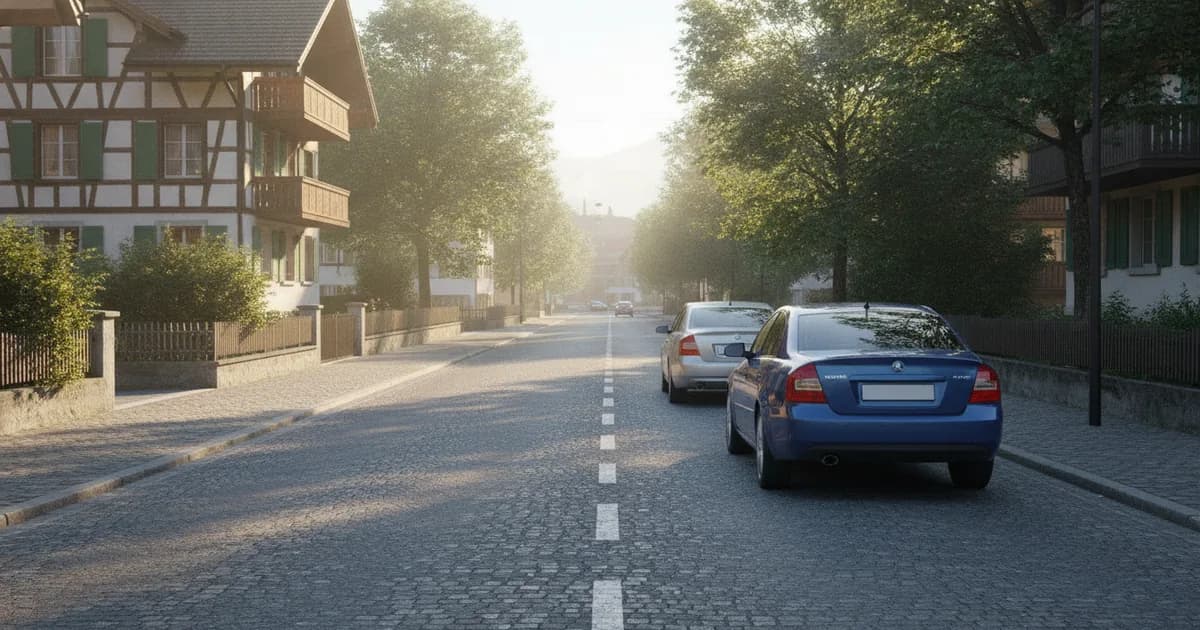
Swiss priority signs: Stop, Give way, Main road & the right-of-way sign
All 8 Swiss priority signs explained: Stop, Give way, Main road, the right-of-way sign and narrow sections – with the rolling-stop fine and exam traps.
Quick answer: what are priority signs?
Priority signs (German Vortrittssignale) tell you at a junction who may go first. In the Swiss Signalling Ordinance (SSV) they form the 3.xx group, and they override the statutory priority-to-the-right rule (Art. 27(1) and Art. 36(2) SVG). Switzerland currently uses eight priority signs:
- You must give way: «Stop» (3.01) and «Give way» (3.02, Kein Vortritt)
- You have priority: «Main road» (3.03) and «Junction with a road without priority» (3.05)
- Priority to the right applies (again): «End of main road» (3.04) and «Junction with priority to the right» (3.06)
- Narrow sections: «Give way to oncoming traffic» (3.09) and «Priority over oncoming traffic» (3.10)
Remember the ranking: police before traffic lights, traffic lights before priority signs, priority signs before priority to the right. The general right-of-way rules (pedestrians, trams, roundabouts, mountain roads) are covered in Right of way in Switzerland. This article is only about the signs – exactly the picture questions where many candidates lose points in the theory test.
Basic rule: priority to the right unless a sign says otherwise
Art. 36(2) SVG is short: at junctions, the vehicle coming from the right has priority. Vehicles on a marked main road have priority even if they come from the left. Regulation by signs or by the police takes precedence.
That gives you the key exam idea: you do not need a «priority to the right» sign. Wherever no priority sign, no road marking and no traffic light regulates the junction, right before left applies automatically – inside and outside built-up areas. The sign many people search for as the «right-of-way sign» is really an advance warning (3.06, see below).
The order of rules is fixed in law: police instructions override everything; signs and markings override the general rules (Art. 27(1) SVG). Traffic lights override the priority rules, priority signs and markings (Art. 68(1) SSV). At a junction with lights you only follow «Stop» and «Give way» when the lights are not regulating traffic, for example because they are switched off (Art. 36(3) SSV).
«Stop» (3.01): come to a full stop, then give way
Looks like: red octagon with the white word STOP. On the road you will find a continuous white stop line (6.10) and the word «Stop» painted on the surface (6.11) (Art. 75(2) SSV).
- Duty: stop and give way to vehicles on the road you are approaching (Art. 36(1) SSV) – even if the road looks empty.
- Where to stop? At the stop line. The front of your vehicle must not cross it (Art. 75(1) SSV). If you still cannot see, creep forward slowly and look again.
- Why there? A stop sign may only be placed where stopping is essential because of poor visibility (Art. 36(7) SSV). A «rolling stop» is therefore not a minor detail.
Fine: not stopping completely at a stop sign costs CHF 60 as a fixed fine in a car or on a motorcycle (OBV Annex 1 no. 308), and CHF 30 on a bicycle or moped (no. 614). If you endanger someone, it is no longer a fixed fine (see below).
«Give way» (3.02): be ready to brake, stop only if needed
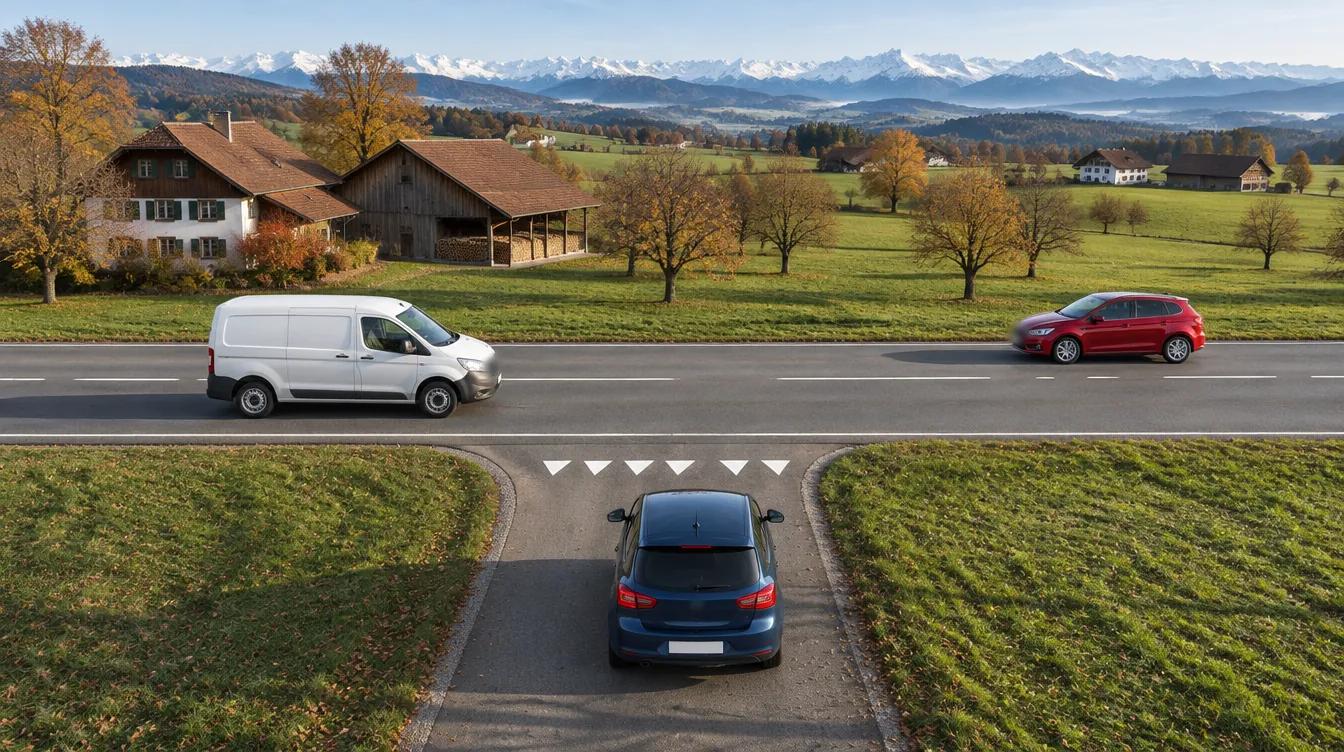
Looks like: triangle pointing downwards with a red border and white field. On the road: the give-way line, a row of white triangles across the lane (6.13). On main roads and important side roads, a large painted triangle can announce the give-way line (6.14, Art. 75(3)–(4) SSV).
- Duty: give way to vehicles on the road you are approaching (Art. 36(2) SSV). You only stop if someone is coming.
- Do not obstruct: a driver who must give way may not obstruct the driver with priority, must slow down in good time and, if waiting is necessary, stop before the junction begins (Art. 14(1) VRV). If your turn forces the other driver to brake, you have already failed to give way.
- Motorway slip roads: here «Give way» stands right before the motorway and the give-way line is omitted (Art. 88(1) SSV).
«Main road» (3.03) and «End of main road» (3.04)
Looks like: yellow square standing on its point, with a white and a black border. The end sign is crossed out with black diagonal bars.
- Main road: at the following junctions, priority to the right is cancelled – you have priority, even over vehicles from the right (Art. 37(1) SSV). The sign is repeated shortly before junctions in built-up areas and shortly after them outside, and may be missing at minor junctions (para. 2).
- Special rules: parking on main roads is forbidden outside built-up areas, and inside them where two motor vehicles could no longer pass each other (Art. 19(2) VRV).
- End of main road: from the next junction, priority to the right applies again (Art. 38 SSV). The sign is announced 150–250 m ahead outside built-up areas and about 50 m ahead inside, with a distance plate.
Exam trap – the main road turns: when the main road changes direction, the supplementary plate «Direction of the main road» (5.09) shows its course (Art. 65(1) SSV). If you follow the main road, you still indicate, because every change of direction must be signalled (Art. 28(1) VRV). If you leave the main road into a side road, you only need to give way to oncoming traffic on the main road (Art. 15(1) VRV).
«Junction with a road without priority» (3.05)
Looks like: triangle with a red border, point up, showing a thick black vertical bar crossed by a thin bar.
This sign stands on side roads and means: at the next junction you have priority (Art. 39(1) SSV). It applies to that one junction only, not to the whole road – unless a «Length of section» plate (5.03) gives a distance. In built-up areas it may be missing if you can see that the road joining from the right has a Stop, a Give way or a stop/give-way line (para. 2).
«Junction with priority to the right» (3.06): the so-called right-of-way sign
Looks like: triangle with a red border, point up, with a black «X».
On side roads this sign announces a junction where the statutory priority to the right applies (Art. 40(1) SSV). It is only put up if you cannot see the road from the right in time, or if priority to the right suddenly applies again after several junctions marked with 3.05 (para. 2). Without it, priority to the right still applies. The sign is a warning, not a free pass for the driver coming from the right: drivers with priority must also take care of road users who could not see them in time (Art. 14(2) VRV).
Narrow sections: «Give way to oncoming traffic» (3.09) and «Priority over oncoming traffic» (3.10)
- 3.09 (round, red border, a red and a black arrow): if you drive in the direction of the red arrow, you give way to oncoming traffic in the narrow section. Single-track vehicles (bicycles, motorcycles) need not wait if passing is safely possible (Art. 42(1) SSV).
- 3.10 (blue square, a white and a red arrow): if you drive in the direction of the white arrow, you may continue. If the oncoming vehicle is already in the narrow section, you must wait (Art. 42(2) SSV).
Without a sign, the general rules for passing apply; steep mountain roads have their own special rule.
The four most common exam traps
- Two stop roads facing each other: if several roads with «Stop» or «Give way» meet the priority road at the same place, priority to the right applies between them (Art. 15(2) VRV). Stopping first does not mean going first.
- Stationary queue: even if the nearer queue on the priority road is stopped, you still have no priority over the parallel lane (Art. 14(3) VRV). «Slipping through» a gap is a classic cause of crashes.
- Exits and pavements: anyone pulling out of a car park, garage, farm track, cycle path or across a pavement onto the road must give way to everyone – with or without a sign (Art. 15(3) VRV).
- Turning left on the main road: the main road gives you priority over crossing traffic, but not over oncoming traffic. When turning left, let oncoming vehicles go first (Art. 36(3) SVG).
At roundabouts, «Give way» stands before the entry together with the «Roundabout» sign: you give way to vehicles already in the circle coming from the left (Art. 24(4) SSV). More in Roundabouts in Switzerland. How traffic lights take over at junctions is explained in Traffic lights in Switzerland.
Failing to give way: what are the consequences?
A rolling stop has a fixed fine. Actually failing to give way at a junction, however, is not in the fixed-fine list. It is reported and decided in ordinary criminal proceedings: a fine under Art. 90(1) SVG, or, if serious danger was caused, a gross traffic offence under Art. 90(2) SVG. The amount depends on the canton and the case.
In parallel, the road traffic office considers an administrative measure: a warning for a minor offence (Art. 16a SVG), at least one month's licence withdrawal for a medium offence (Art. 16b SVG), at least three months for a serious one (Art. 16c SVG). How the levels work is explained in Licence withdrawal in Switzerland.
How to learn priority signs for the theory test
Learn the signs in pairs: Stop/Give way (duty to yield), Main road/End (priority on/off), 3.05/3.06 (next junction: you have priority or right goes first), 3.09/3.10 (narrow section). Then practise them in scenes with several vehicles, because that is how the basic theory test asks. Start with the free online theory test or the demo. If you want all official questions with explanations, unlock them on the pricing page.
FAQ
Is there a «priority to the right» sign in Switzerland?
No sign is needed: without a sign, priority to the right applies automatically. The triangle with the black «X» (3.06) only announces such a junction.
What is the difference between «Stop» and «Give way»?
At a Stop you must always come to a full stop, even if nobody is coming. At «Give way» you only stop if you have to let someone pass.
How much is a rolling stop?
CHF 60 fixed fine in a car (OBV no. 308), CHF 30 on a bicycle or moped (no. 614).
Does the «Main road» sign apply until the end sign?
Yes, until the «End of main road» sign (3.04). It is not always repeated at minor junctions.
Does «Give way» apply when the light is green?
No. Traffic lights override priority signs. «Stop» and «Give way» only apply when the lights are not regulating traffic, for example because they are switched off.
Sources
- Road Traffic Act (SVG, SR 741.01): Art. 27(1), Art. 36(2)–(4), Art. 16a–16c, Art. 90(1) and (2)
- Signalling Ordinance (SSV, SR 741.21): Art. 24(4), 35–40, 42, 65(1), 68(1), 75, 88(1); Annexes 1 and 2 (signs 3.01–3.10)
- Traffic Rules Ordinance (VRV, SR 741.11): Art. 14, 15, 19(2), 28(1)
- Fixed Fines Ordinance (OBV, SR 314.11): Annex 1 no. 308 and 614
Note: not legal advice; the laws in force and the individual case are decisive. Official sign names are German/French/Italian; English names here are translations.
Start free demo · Learn online for free · Unlock 60 days · Order