Swiss motorway rules: 120 km/h, hard shoulder, zip merge & fines
Swiss motorway rules explained: 120 km/h, who may enter, zip merge, passing on the right, hard shoulder, emergency corridor and the fixed fines.
Quick answer: the key motorway rules in Switzerland
Swiss motorways (Autobahn) have a handful of special rules that the theory exam asks about again and again. Know them and you save points in the exam and expensive fines on the road:
- 120 km/h on motorways and 100 km/h on expressways (Autostrasse), unless a sign shows something else (Art. 4a para. 1 VRV).
- Motor vehicles only, and only those that can and may reach at least 80 km/h. Tractors, vehicles with studded tyres and motorcycles up to 50 cc or 4 kW are excluded (Art. 35 VRV).
- No U-turns, no reversing; turning off only at marked points (Art. 36 para. 1 VRV).
- Hard shoulder for emergency stops only, and nobody steps onto the carriageway (Art. 36 para. 3 VRV).
- Right of way for the motorway over vehicles on the slip road. In slow traffic the zip merge applies (Art. 36 para. 4 VRV).
- Overtaking on the right is forbidden (swinging out and back in); passing on the right is allowed only in four precisely defined cases (Art. 36 para. 5 VRV).
- Emergency corridor in stop-and-go traffic or when stationary (Art. 36 para. 7 VRV).
This article goes through the rules one by one, lists the fixed fines and shows the typical exam traps. The plain speed limits for every road type are in Speed limits in Switzerland. Here we cover what applies additionally on motorways and expressways only. The official legal texts are in German, French and Italian; the English terms here are translations.
Motorway and expressway: what is the difference?
Both are reserved for motor vehicles, and the same special rules apply to both (Art. 35 and 36 VRV). You recognise them by the signs "Motorway" (4.01) and "Expressway" (4.03); the signs "End of motorway" (4.02) and "End of expressway" (4.04) end the special rules again (Art. 45 para. 1 SSV). A motorway sign also cancels all previously signposted restrictions.
The practical difference is mainly speed: 120 km/h on the motorway, 100 km/h on the expressway. Motorways also have separate carriageways with a central reservation. You fall back to the general 80 km/h outside built-up areas only after the "End of motorway" or "End of expressway" sign (Art. 4a para. 3 VRV). In the fine schedule, expressways use the table for "outside built-up areas", while motorways have their own, somewhat milder table (see below).
Who may use the motorway?
Only motor vehicles that can and may reach at least 80 km/h (Art. 35 para. 1 VRV). Exceptions are road maintenance vehicles, special vehicles and special transports. Not allowed on the motorway or expressway:
- tractors and tracked vehicles,
- vehicles with studded tyres,
- motorcycles up to 50 cc or at most 4 kW (Art. 35 para. 2 VRV).
Bicycles, pedestrians and mopeds are excluded as well: on roads reserved for motor vehicles, access is prohibited (Art. 43 para. 3 SVG). A broken-down vehicle may be towed only to the next exit (para. 3), and test drives and sporting events are not permitted (para. 4).
Fines (OBV Annex 1 no. 327): motorcycle up to 50 cc or 4 kW CHF 100, other vehicle not admitted CHF 140, studded tyres CHF 60, towing beyond the next exit CHF 140.
Speed on the motorway: 120, minimum speed and tolerance
The general limit of 120 km/h applies from the "Motorway" sign (4.01) until the "End of motorway" sign (Art. 4a para. 4 VRV). Different signs take priority: many sections show 100, 80 or even 60 km/h, for example at junctions, in tunnels or at roadworks. Signposted reductions go down in steps of 10 km/h to 60 km/h (Art. 108 para. 5 SSV). Lower limits for certain vehicle types, such as vehicles with a trailer, apply as well.
Is there a minimum speed? The law sets no general lower limit such as 60 km/h. The only requirement is that the vehicle can and may reach 80 km/h. A signposted minimum speed exists only with sign 2.31; vehicles that cannot go that fast must not continue there (Art. 23 SSV). Regardless, you must always adapt your speed to the circumstances (Art. 32 para. 1 SVG).
Tolerance with radar and laser: the device and measurement uncertainty set by the federal roads office (ASTRA) is deducted from the measured speed. Only the remainder counts as speeding. How this works, and why measurement methods deduct different amounts, is explained in Speeding in Switzerland.
Fixed fines for speeding on the motorway
Motorways have their own table (OBV Annex 1 no. 303.3), applied after the measurement uncertainty has been deducted:
- 1–5 km/h too fast: CHF 20
- 6–10 km/h: CHF 60
- 11–15 km/h: CHF 120
- 16–20 km/h: CHF 180
- 21–25 km/h: CHF 260
For comparison: outside built-up areas and on expressways, even 1–5 km/h costs CHF 40 and 16–20 km/h costs CHF 240 (no. 303.2). More than 25 km/h over means no fixed fine any more but a police report. Criminal proceedings follow and a licence withdrawal is considered (Art. 16 ff. SVG, see Licence withdrawal in Switzerland).
A particularly flagrant disregard of the speed limit ("Raserdelikt") is defined, where more than 80 km/h is allowed, as exceeding it by at least 80 km/h, so from 200 km/h on a 120 section. This is a serious offence with a minimum prison sentence of one year (Art. 90 paras. 3 and 4 SVG), although mitigation is possible. The licence is withdrawn for at least two years (Art. 16c para. 2 let. abis SVG). The figure itself is rarely tested, but the logic is: the higher the limit, the bigger the margin before it counts as "road racing".
Joining and leaving: right of way and zip merge
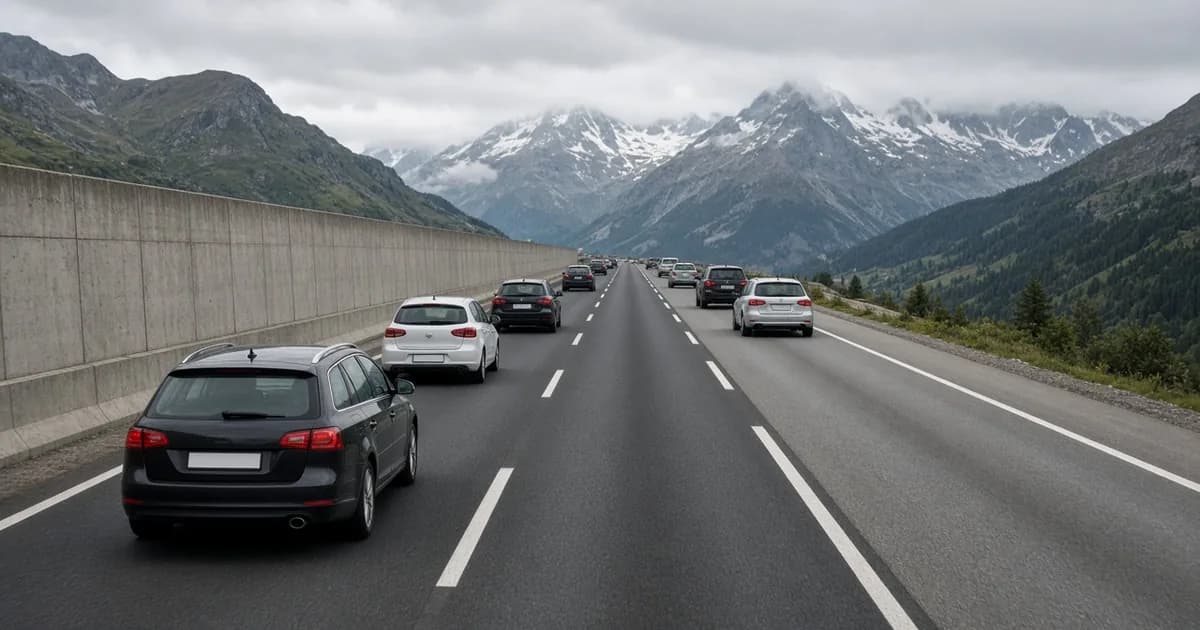
On the slip road you have no right of way. People on the motorway have priority over vehicles on the access road (Art. 36 para. 4 VRV). On the acceleration lane you match your speed to the flowing traffic and move over as soon as there is a gap. Pushing slowly onto the main lane obstructs and endangers others.
Where a lane ends or traffic is queuing, the zip merge applies: immediately before the narrowing, vehicles that cannot continue must be allowed to move into the neighbouring lane alternately (Art. 8 para. 5 VRV). It is used on slip roads in slow traffic as well (Art. 36 para. 4 VRV). Ignoring it costs CHF 100 (OBV Annex 1 no. 306.4).
Exam tip: you drive on to the end of the lane and then take turns merging. Moving over too early is wrong, and so is blocking the gap out of annoyance.
When leaving, move to the right lane in good time and slow down only on the deceleration lane. If you miss the exit, the next one is your only option: U-turns and reversing are prohibited on motorways and expressways (Art. 36 para. 1 VRV), and the central reservation must not be crossed even at existing gaps (para. 2). Since 1 July 2026 a new wording applies: exceptions to the crossing ban exist only where yellow-orange markings or switched-on in-road lights lead a lane across the gap (Art. 36 para. 2 VRV).
Lanes, overtaking and passing on the right
On multi-lane roads: keep as far right as possible and use the left only to overtake (Art. 8 para. 1 VRV). Staying in the left or middle lane without reason costs CHF 60 (OBV no. 314.1). On motorways with at least three lanes in one direction, the far-left lane may be used only by vehicles allowed to drive faster than 100 km/h (Art. 36 para. 6 VRV). Otherwise CHF 60 (no. 328.2). This affects, for example, vans with trailers restricted to 80 km/h.
Overtaking on the right by swinging out and back in is forbidden on the motorway. It costs CHF 250 (no. 314.3). Passing on the right, i.e. driving past slower traffic in your own lane, is different. It is allowed with due care only:
- in queuing traffic on the left or middle lane,
- on pre-selection lanes with different destinations per lane,
- on the acceleration lane, as long as the lane to the left is separated by a safety line (see Safety line in Switzerland),
- on the deceleration lane of exits (Art. 36 para. 5 VRV).
Unauthorised passing on the right costs CHF 200 on the motorway (no. 314.5). More about overtaking is in Overtaking in Switzerland. Also forbidden: overtaking a vehicle that is itself overtaking, except on divided roads with at least three lanes in your direction (Art. 11 para. 2 VRV).
Keeping your distance on the motorway
"Distance on the motorway" is among the most searched questions on this topic. The law names no fixed number of metres. It requires sufficient distance so that you can stop in time even if the vehicle ahead brakes unexpectedly (Art. 12 para. 1 VRV). A common rule of thumb is the 2-second gap: the car ahead passes a point and you reach it no sooner than two seconds later. In the wet, leave more. How distance is measured and punished is explained in Safe following distance and Distance measurement.
Hard shoulder, breakdown and emergency stop
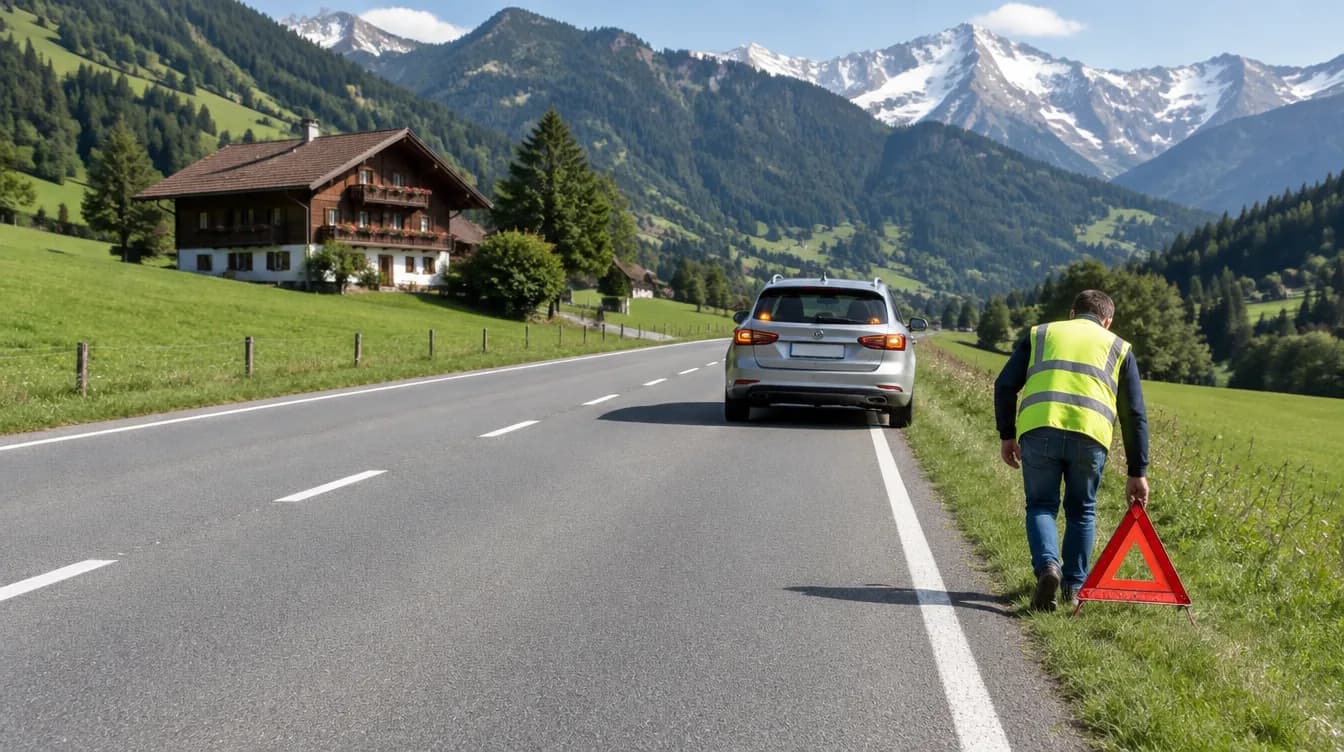
The hard shoulder is neither a parking space nor an overtaking lane. It may be used for emergency stops only, and occupants must not step onto the carriageway (Art. 36 para. 3 VRV). On stretches without a hard shoulder there is the sign "Lay-by for broken-down vehicles" (4.16). Where sign 4.77.2 "Hard shoulder open" appears, it may exceptionally be driven on (Art. 59 SSV).
If you break down, stop as far to the right as possible, switch on the hazard lights and secure the spot. When and how to use the warning triangle is covered in Warning triangle in Switzerland.
Fines (OBV Annex 1):
- Driving on the hard shoulder: CHF 140 (no. 328.1)
- Parking on the hard shoulder up to 60 minutes: CHF 120, stopping without an emergency: CHF 80 (no. 226)
If you come to a halt on the hard shoulder or a lay-by because you ran out of fuel or electric charge, you pay CHF 120 (no. 340, Art. 29 SVG). An empty tank is therefore no excuse.
Emergency corridor: always between the left-hand lanes
If vehicles on a motorway or expressway with at least two lanes per direction are crawling or standing still, they form a corridor between the far-left lane and the lane next to it (Art. 36 para. 7 VRV). That applies immediately, not only once you hear a siren. Failing to form it costs CHF 100 (no. 328.3). Details, including what to do with more than two lanes, are in Emergency corridor in Switzerland.
Typical exam traps on motorways
- "120 always applies on the motorway": wrong. Other signs take priority, and lower limits apply with a trailer.
- Expressway = motorway: same special rules, but only 100 km/h.
- The slip road has priority: no, the motorway has priority. In a queue the zip merge applies.
- U-turn after missing the exit: forbidden. Continue to the next exit.
- Hard shoulder for overtaking or a break: forbidden, emergency stops only.
- Overtaking on the right in a jam: passing on the right in a queue is allowed, swinging out and back in is not.
- Left lane for slow vehicles: on three-lane motorways only for vehicles allowed to drive faster than 100 km/h.
- Studded tyres: forbidden on motorways and expressways, whatever the season.
How to practise motorway questions for the theory exam
Most motorway questions are picture or situation questions: you see a slip road, a traffic jam or a lane change and decide who has priority, where you may drive and what is forbidden. Learn the five core rules first (speed, admission, no U-turns, hard shoulder, priority), then practise the exceptions such as passing on the right and the emergency corridor with real picture questions. Signs 4.01 to 4.04 are part of the syllabus as well.
With the free demo you can check your level straight away. If you want to learn systematically, learn the theory test online for free is the way in, and pricing shows the options with all questions and exam simulation. Ready to start? Order now.
FAQ
How fast can you drive on the motorway in Switzerland?
120 km/h unless another sign applies. On expressways it is 100 km/h (Art. 4a para. 1 VRV). With a trailer, in tunnels or at roadworks, lower limits often apply.
Is there a minimum speed on the motorway?
Only indirectly: the vehicle must be able to and allowed to reach 80 km/h. A fixed lower limit applies only where the "Minimum speed" sign (2.31) stands.
What does speeding on the motorway cost?
After deducting the measurement uncertainty: CHF 20 for 1–5 km/h, CHF 60 for 6–10, CHF 120 for 11–15, CHF 180 for 16–20 and CHF 260 for 21–25 km/h too fast. Beyond that there is a police report.
May you overtake on the right on the motorway?
No. Passing on the right is allowed only in queuing traffic, on pre-selection lanes and on acceleration and deceleration lanes (Art. 36 para. 5 VRV). Overtaking on the right costs CHF 250.
What if I miss my exit?
Continue to the next exit. U-turns, reversing and stopping on the hard shoulder are forbidden.
Who has priority: the motorway or the slip road?
The motorway. In slow traffic you merge alternately (zip merge).
Sources
- Road Traffic Act (SVG, SR 741.01): Art. 16–16c, Art. 29, Art. 32 para. 1 and 2, Art. 43 para. 3, Art. 90 para. 1–4
- Traffic Rules Ordinance (VRV, SR 741.11): Art. 4a, 8, 11 para. 2, 12, 35, 36
- Signalling Ordinance (SSV, SR 741.21): Art. 23, 45 para. 1, 59, 90, 108 para. 5; signs 2.31, 4.01–4.04, 4.16, 4.77.2
- Fixed Fines Ordinance (OBV, SR 314.11): Annex 1 no. 226, 303, 306.4, 314, 327, 328, 340
Note: not legal advice; the laws in force and the individual case are decisive. Official names are German/French/Italian; English names here are translations.
Start free demo · Learn online for free · Unlock 60 days · Order