Emergency corridor Switzerland: form it, hard shoulder & theory exam
Swiss emergency corridor for the theory exam: when to form it, 2–4 lanes, hard shoulder vs corridor and typical traps – clear and practise-ready.
Short answer — what is the Rettungsgasse?
For the Swiss emergency corridor (Rettungsgasse), the theory exam mainly tests situational judgement: Do you recognise when a free corridor for police, ambulance, fire and other help vehicles must open on a motorway or expressway – and which way you move your vehicle? This short answer is for skimming – the sections below cover when, how (2/3/4 lanes), the hard-shoulder distinction and typical traps.
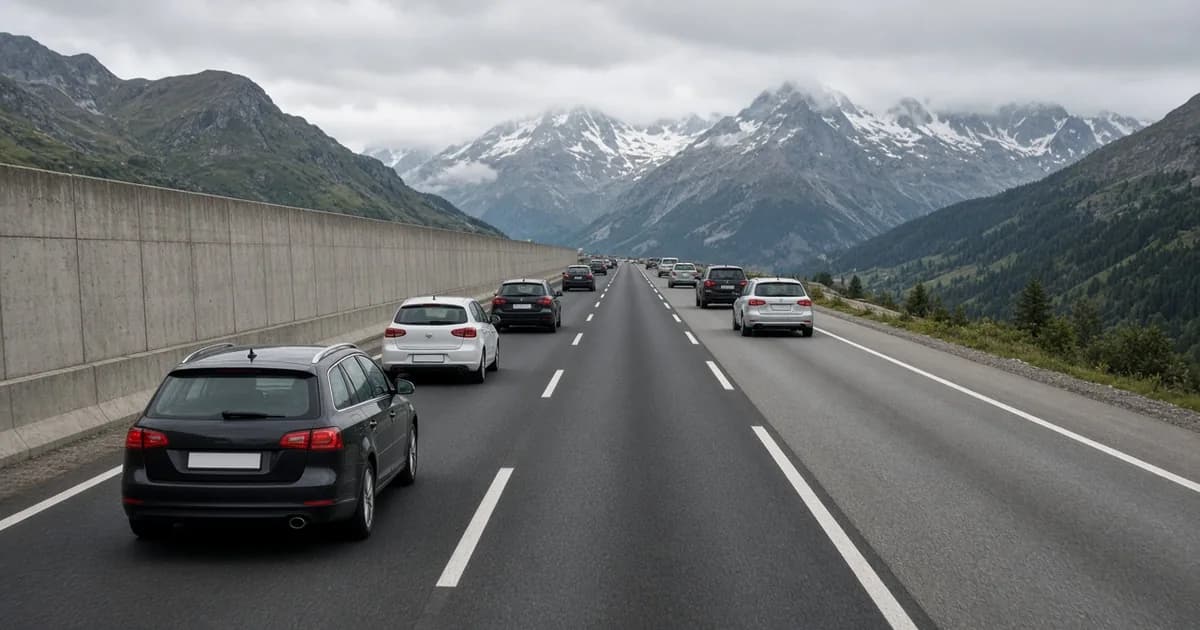
- When: On motorways and expressways (Autobahn / Autostrasse) with at least two lanes in one direction, form the corridor as soon as vehicles only crawl at walking pace or stand still – early, at the latest when traffic is crawling, even if no blue lights are visible yet.
- Where the corridor lies: Between the outermost left lane and the lane immediately to its right – not on the hard shoulder (Pannenstreifen) at the edge.
- Two lanes: Left lane moves left, right lane moves right → gap in the middle.
- Three or more lanes: Only the far-left lane moves left; all other lanes move right → corridor always between the left-most lane and the next lane to its right.
- Not the hard shoulder: The Pannenstreifen is the standstill strip at the carriageway edge; the Rettungsgasse is the emergency corridor between the lanes. Right-hand traffic (RHT) – no left-hand-traffic framing.
Rules hub: Swiss traffic rules. Motorway behaviour and overtaking: Overtaking in Switzerland.
When must you form a Rettungsgasse?
The exam core for forming the Swiss emergency corridor is not “Do I already see blue lights?”, but: Is traffic crawling or stopped on a motorway or expressway with at least two lanes in the direction of travel? Then you must create the free corridor – and early. Waiting until emergency vehicles are audible or visible is exam-wise too late.
This deep-dive owns the Rettungsgasse itself: when, left/right lane choice, dissolving it again and the boundary vs the hard shoulder. Speed defaults, distance in a queue and overtaking stay in the linked articles – here you train the emergency corridor.
Congestion and crawling traffic
- Walking pace or standstill: As soon as the queue only creeps or stands, form the Rettungsgasse. ASTRA framing: early, at the latest at walking pace.
- Without a visible emergency vehicle: You form the corridor before police, ambulance or fire appear in the mirror. Making space only when lights flash misses the exam and safety logic.
- Crawling traffic counts: Not only a “total jam” – dense, crawling traffic on motorway/expressway triggers the duty once speed and gaps effectively mean standstill.
- Calm and predictable: Lane moves for the corridor without hectic cutting; indicate and look so neighbours can react.
Distance in the queue remains part of the picture – bridge: Safety distance Switzerland.
Motorway vs expressway (Autobahn vs Autostrasse)
Exam-wise the same Rettungsgasse logic applies on motorway and expressway when there are at least two lanes in one direction. The Autobahn/Autostrasse difference is mainly speed limits and signing – not “corridor only on the motorway”. Read the picture: multi-lane one way, crawling or stopped → corridor between far left and the lane to its right.
Speed limits and defaults by road type: Swiss speed limits. Signals in words: Swiss traffic signs.
Note: Framing follows typical syllabus/ASTRA logic (incl. VRV Art. 36 para. 7 style): at walking pace or standstill, leave a free corridor for police, ambulance, fire, customs and help vehicles between the outermost left lane and the lane immediately to its right. Not legal advice and not a substitute for official guidance.
How to form the Rettungsgasse correctly
Geometry is the exam classic. Do not memorise “somewhere make space”, but exactly between far left and the next lane to the right. All examples assume Swiss right-hand traffic.
Two lanes — who goes left, who goes right
- Left lane: Vehicles move as far as possible to the left (to the left edge of the left lane).
- Right lane: Vehicles move as far as possible to the right.
- Result: A free corridor opens in the middle – the Rettungsgasse – for emergency vehicles.
Exam trap: both lanes “somehow to the right” or the left lane moving right → the corridor is wrong or missing. With two lanes, the middle is the clear answer.
Three or more lanes — mnemonic
- Only the outermost left lane moves left.
- All other lanes (middle, right, and a possible fourth) move right.
- The corridor always lies between the far-left lane and the lane immediately to its right – not between middle and right, not on the hard shoulder.
Mnemonic (right hand): thumb = left lane (goes left); other fingers = all other lanes (go right); the gap between thumb and index finger = Rettungsgasse. With three and four lanes you stay calm: never “everyone shares somehow” – always far left vs the rest to the right.
Four lanes follow the same rule: outermost left to the left, lanes 2–4 to the right. The emergency path stays between lane 1 and lane 2.
Entering / dissolving again when traffic flows
- Entering the corridor: The Rettungsgasse is for emergency and help vehicles – not a shortcut, not for “creeping past” the queue and not for overtaking the column.
- Dissolving: Once traffic flows again and there is no need, resume normal lane position and lane discipline – without artificially keeping the gap open when everyone is moving.
- After an emergency vehicle: Do not rush into the freshly used gap; first read the queue’s speed and situation.
Overtaking and column behaviour on the motorway: Overtaking in Switzerland – depth on passing on the right in a column lives there; this post owns the Rettungsgasse.
Rettungsgasse vs hard shoulder (Pannenstreifen)
The most common mix-up for Rettungsgasse vs Pannenstreifen Switzerland: many think the emergency path is the strip at the edge. Exam-wise wrong.
- Rettungsgasse: Free corridor between the lanes – in RHT between the outermost left lane and the lane to its right – for police, ambulance, fire and comparable help.
- Pannenstreifen (hard shoulder): Standstill strip at the outer carriageway edge for breakdowns, own-vehicle emergencies and similar situations – not the regular rescue corridor of the queue and not an overtaking lane.
Short and clear: do not use the hard shoulder as a shortcut and do not misread it as “overtake on the far right”. Rules on overtaking and when the hard shoulder is taboo belong in the overtaking article: Overtaking in Switzerland. Here the boundary is enough: Rettungsgasse ≠ Pannenstreifen.
Typical theory-exam traps
No copyrighted exam dumps – only exam-style rule explanations for the Swiss Rettungsgasse. Use the list as a training check: read each trap with the lane picture in mind (two vs three lanes, corridor position, hard shoulder).
- “Form it only when I see blue lights?” – Too late. Early / at the latest at walking pace or standstill – even without a visible emergency vehicle.
- “With three lanes we split in the middle?” – No. Only the far-left lane to the left; all others to the right. Corridor between far left and the next lane.
- “The Rettungsgasse is the hard shoulder?” – No. Hard shoulder = edge; Rettungsgasse = between the lanes.
- “With two lanes both go right?” – Wrong. Left to the left, right to the right → middle free.
- “I use the corridor to pass the queue” – Exam-wise wrong. The corridor is for emergency and help vehicles, not a shortcut.
- “Disregarding the Rettungsgasse – does ‘I heard nothing’ count?” – In exam logic, forming the corridor in time counts. Excuses do not replace the rule; we deliberately invent no CHF fine amounts here.
Distance, speed and behaviour in a jam
Rettungsgasse pictures are often jam pictures: tight gaps, restless lane changes, unclear speed differences. Two bridges – without rewriting the other posts:
- Distance: In the queue you need enough room to shift for the corridor without touching the vehicle ahead. More: Safety distance Switzerland.
- Speed: Crawling traffic and walking pace are exactly when the Rettungsgasse applies – not “still 80 because motorway”. Limits and defaults: Swiss speed limits.
Behaviour: calmly move left or right, keep the corridor open, do not park in the gap for emergency vehicles. Overtaking the queue via the hard shoulder or through the Rettungsgasse is not the answer – see again Overtaking in Switzerland.
How to practise Rettungsgasse & motorway questions online for free
Many errors happen because “Rettungsgasse” is read as a keyword instead of lane geometry. Goal when practising: stable pattern recognition – two vs three lanes, corridor position, hard-shoulder boundary. In the simulation, check briefly:
- Where am I? – Motorway / expressway, at least two lanes one way?
- Is traffic crawling or stopped? – then form the corridor early
- How many lanes? – two → middle; three+ → only far left to the left
- Hard shoulder or Rettungsgasse? – edge vs between the lanes
- Shortcut through the corridor? – no; emergency vehicles first
Practise exam-style:
- Start with the demo and filter motorway and jam situation questions.
- Practise mixed sets under learn the theory test online free.
- Move to full simulations via learn driving theory.
- Light upsell if needed: packages & prices.
Note: Organisational details can vary by canton. If in doubt, ask the competent road traffic office – this article does not replace official guidance.
FAQ
When must I form the Rettungsgasse?
On motorway and expressway with at least two lanes in one direction, as soon as vehicles drive at walking pace or stand still – early, even without visible blue lights. Overview: Swiss traffic rules.
Where do I go with two lanes?
Left lane as far left as possible, right lane as far right as possible. The free corridor opens in the middle.
Is the Rettungsgasse the hard shoulder?
No. The hard shoulder (Pannenstreifen) lies at the carriageway edge; the Rettungsgasse lies between the lanes (between far left and the lane to its right).
May I drive / overtake on the hard shoulder?
Exam-wise: do not misuse the hard shoulder as a shortcut or overtaking lane. Overtaking details: Overtaking in Switzerland.
Does the Rettungsgasse also apply in built-up areas?
The classic Rettungsgasse duty in ASTRA/VRV framing refers to motorways and expressways with at least two lanes in one direction. In town, other consideration and making way for emergency vehicles apply – but not the same “lane geometry” pattern as on the motorway. Read the picture and the situation.
Ready to solve Rettungsgasse questions calmly?
Form early in a jam or at walking pace, keep the middle free with two lanes, with three or more only far left to the left and all others to the right, do not confuse Rettungsgasse with the hard shoulder and do not use the corridor as a shortcut – that is the exam core for the Swiss Rettungsgasse. Connect with Swiss traffic rules, overtaking, safety distance and speed limits, and practise situation pictures. Stable judgement under time pressure saves error points.
Practise free online · Start demo · Choose a package · Order