No-stopping zones in Switzerland: absolute vs restricted, parking ban & yellow line
Absolute or restricted? No-stopping vs parking ban, yellow curb markings, fixed fines and what the Swiss theory test asks.
Quick answer: what does a no-stopping ban mean in Switzerland?
In Switzerland, the signal “No stopping” (2.49) bans voluntary stopping on the signed side of the road. The signal “No parking” (2.50) only bans parking — a short stop to let people on or off, or to load goods, remains allowed (Art. 30 para. 1 SSV; parking defined in Art. 19 para. 1 VRV).
For the theory test, remember:
- Absolute no-stopping: signal 2.49 or the continuous yellow no-stopping line (6.25) — you must not stop voluntarily.
- Restricted no-stopping: often a supplementary plate with times — the ban applies only during those times. In practice, “restricted” is also contrasted with a parking ban: with no parking you may still stop briefly; with no stopping you may not.
- Yellow road markings at the kerb can have the same effect as signs (Art. 79a SSV).
A short overview of stopping and parking is in Stopping and parking in Switzerland. This article goes deeper: signs, lines, fines and typical test traps.
Stopping or parking — the decisive difference
Parking means leaving a vehicle in a way that is not merely for boarding or alighting, or for handling goods (Art. 19 para. 1 VRV). Anything beyond that — including “just waiting briefly outside the shop” — counts as parking.
Stopping is any halt, even for a few seconds. With “No stopping”, even a voluntary short stop is banned. An emergency stop for danger, a police order or a breakdown is not the same as a voluntary stop.
If signal 2.49 stands at the edge of the carriageway, it also covers the adjacent pavement (Art. 30 para. 2 SSV). More on signs in general: Swiss traffic signs.
Signals 2.49 and 2.50: what is banned where?
- “No stopping” (2.49): no voluntary stopping on the signed side. Even a short pick-up or drop-off is not allowed here.
- “No parking” (2.50): parking banned; boarding/alighting and goods handling remain possible unless something else applies.
Start, repetition and end of the ban are shown with the start plate (5.05), repetition plate (5.04) and end plate (5.06). The scope can also be shown with a direction plate (5.07) (Art. 30 para. 3 SSV). Temporary exceptions from the no-stopping ban use the supplementary plate “Exceptions from the no-stopping ban” (5.10).
Absolute vs restricted: how the theory test asks it
Study cards and exam questions often use absolute and restricted no-stopping. Legally the signal is simply “No stopping”; the distinction helps you judge the effect correctly:
- Absolute: signal 2.49 without a time limit, or the continuous yellow no-stopping line — no voluntary stopping at any time.
- Restricted (in time): a supplementary plate with hours or days hangs under the signal. Outside those times the no-stopping ban does not apply. Always read the plate.
- Compared with a parking ban: many questions check whether you know that under no parking (2.50) a short stop to pick someone up is still allowed, but under no stopping (2.49) it is not. That is the classic “parking ban vs no-stopping” trap.
Where you park in the Blue Zone with a parking disc is explained in Blue Zone Switzerland.
Yellow lines and boxes at the kerb (Art. 79a SSV)
Road markings often replace or reinforce signs. Remember the colours and shapes:
- No-parking line (6.22): yellow, broken by crosses — parking banned; a short stop to board/alight or handle goods remains possible (Art. 79a para. 1 SSV).
- No-parking box (6.23): yellow with a diagonal cross — parking also banned. If it shows e.g. “Taxi”, a disability symbol or a charging station, boarding/alighting and goods handling are only allowed if entitled users are not obstructed.
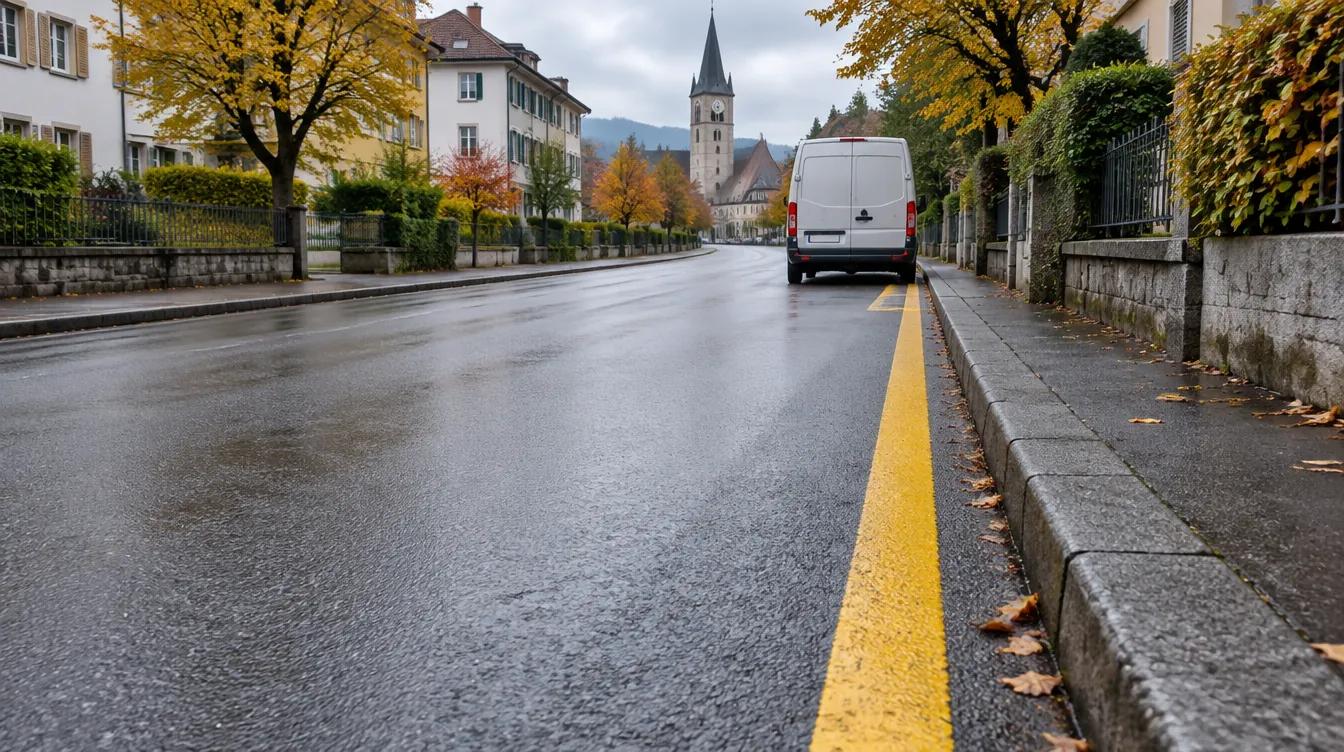
- No-stopping line (6.25): yellow, continuous — bans voluntary stopping at the marked place (Art. 79a para. 2 SSV). This is the “yellow line” many people link to absolute no-stopping.
- Zigzag line (6.21): yellow — public-transport stop. You may stop only to let people on or off, and only if buses and trams are not hindered (Art. 79a para. 3 SSV).
In practice: broken yellow line with crosses = no parking; continuous yellow line = no stopping. Mix them up and you fail the trap question.
Fixed fines: what does a breach cost?
Amounts come from the annex to the Ordnungsbussenverordnung (OBV). These are fixed fines for typical cases — not invented “guide prices”:
- Item 230 OBV — signed no-stopping (2.49): parking up to 60 minutes CHF 120; stopping CHF 80.
- Item 241 OBV — no-stopping line (Art. 79a para. 2 SSV): parking up to 60 minutes CHF 120; stopping CHF 80.
- Item 250 OBV — signed no parking (2.50): parking up to 2 hours CHF 40; more than 2 up to 4 hours CHF 60; more than 4 up to 10 hours CHF 100.
- Item 255 OBV — no-parking line (Art. 79a para. 1 SSV): same scale as item 250 (40 / 60 / 100).
Also relevant: parking on a zigzag line up to 60 minutes also costs CHF 120 (item 239 OBV); obstructive stopping there to board/alight, or stopping for goods handling, CHF 80 each.
Fixed fines are not an administrative measure like a licence withdrawal — but they are costly enough, and the exam wants you to know the difference between no-stopping and no parking, not memorise every franc. More parking context: Stopping and parking in Switzerland.
5 metres before a zebra crossing and other standing bans
Even without a sign: on the carriageway you must not stop or park closer than 5 m before a pedestrian crossing (Art. 18 para. 2 let. e VRV). Before zebra crossings a no-stopping line at least 10 m long is often marked (Art. 77 para. 2 SSV). Details and right of way: Zebra crossings in Switzerland.
Also sensitive: parking closer than 20 m from a level crossing (Art. 19 para. 2 let. e VRV) — see Level crossings in Switzerland. At junctions and narrow spots: do not block sight or crossing traffic; otherwise a fine may follow.
Typical test traps about no-stopping
- “On a yellow line I can briefly let someone out”: Only on the broken no-parking line (with crosses) or under a no-parking signal. On the continuous no-stopping line and under signal 2.49: no.
- “No stopping = no parking”: Wrong. No stopping is stricter.
- “I can ignore the time plate”: Wrong. It limits the ban in time — outside those times you may often stop or park (depending on the signal).
- “On the zigzag I can unload goods”: Wrong. At public-transport stops only boarding/alighting, and only if buses are not hindered; goods handling is not allowed there.
- “2 metres before the zebra is enough”: Wrong. At least 5 m; often a longer marked no-stopping line.
- “A kerbside signal does not cover the pavement”: Wrong for no-stopping 2.49 — it also covers the adjacent pavement.
Pass safely: practise no-stopping for the theory test
No-stopping and parking bans, yellow markings and the 5-metre gap before a crossing are standard material. Knowledge sticks fastest with real exam questions: start with learning the theory test online or the free demo. Unlock all questions with explanations on the pricing page.
FAQ
What is the difference between no-stopping and no parking?
No-stopping (2.49) bans voluntary stopping. No parking (2.50) only bans parking; short boarding/alighting and goods handling remain allowed.
What does the continuous yellow line at the edge mean?
That is the no-stopping line (6.25): no voluntary stopping at the marked place (Art. 79a para. 2 SSV).
What does the yellow line with crosses mean?
No-parking line (6.22): parking banned; a short stop to board/alight or handle goods is possible.
What does parking in a no-stopping zone cost?
Per OBV items 230 and 241: up to 60 minutes CHF 120; mere stopping CHF 80.
What is absolute no-stopping?
In exam practice: signal 2.49 without a time limit, or the continuous yellow no-stopping line — no voluntary stopping at any time.
May I stop briefly before a zebra crossing?
No, if you are closer than 5 m before the crossing — a no-stopping line is often marked there too.
Sources
- Signalisationsverordnung (SSV, SR 741.21): Art. 30 and Art. 79a; signals 2.49/2.50; markings 6.21–6.25; plates 5.04–5.07, 5.10
- Verkehrsregelnverordnung (VRV, SR 741.11): Art. 18 para. 2 let. e, Art. 19 para. 1 and para. 2
- Ordnungsbussenverordnung (OBV, SR 314.11): items 230, 239, 241, 250, 255
Note: Not legal advice; the applicable legislation and the individual case are decisive. Fine amounts from the OBV annex, as in the Fedlex PDF used.
Start free demo · Learn online free · Unlock 60 days · Order