Level crossings in Switzerland: rules, signals & behaviour for the theory test
Swiss level crossings explained: when to stop, barriers, red flashing lights and St Andrew’s cross, bans on overtaking, stopping and parking, and what to do in an emergency.
Short answer: how to behave at a level crossing in Switzerland
A level crossing (Bahnübergang) is where a road and a railway track cross at the same height. For the Swiss theory test you need these rules down cold:
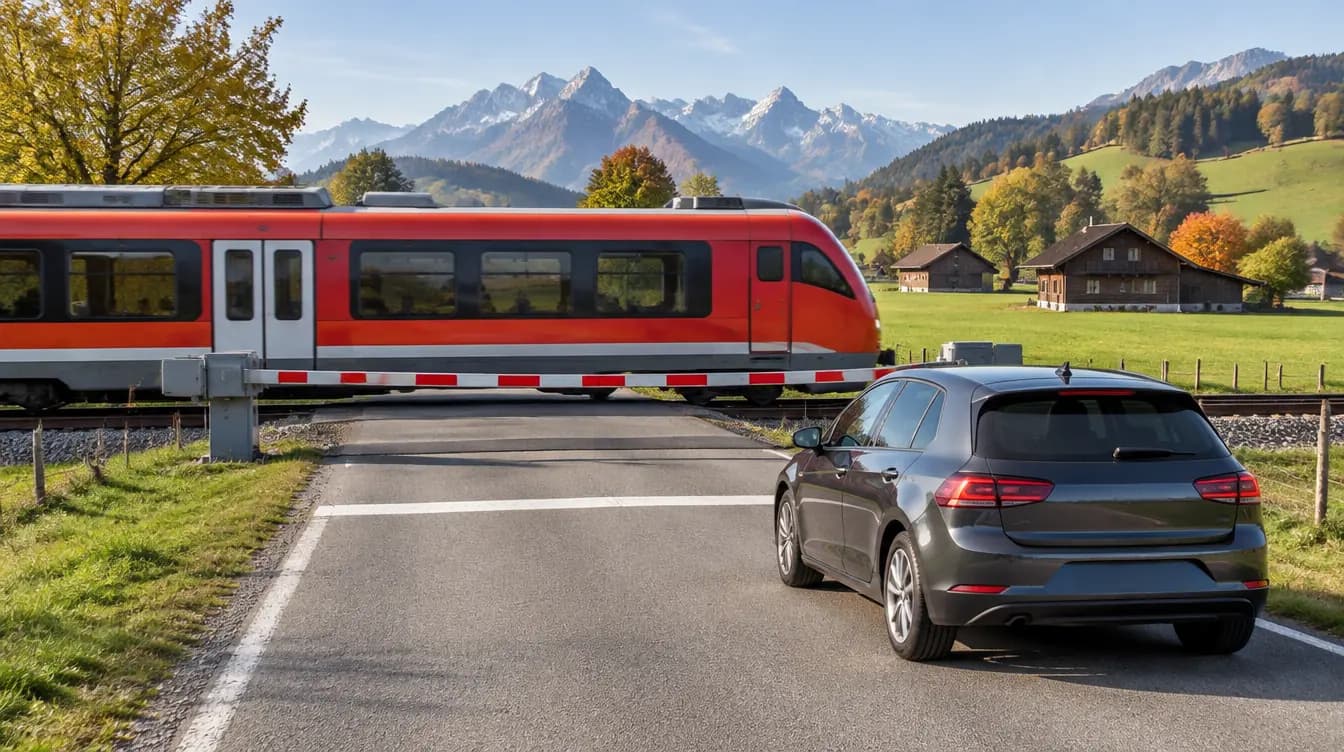
- Stop when barriers are closed or closing, when a red flashing light is on or an acoustic signal sounds (Art. 28 SVG, Art. 93 para. 2 SSV).
- If there are no barriers and no flashing lights (only a St Andrew’s cross), you must check for yourself that no train is approaching and the crossing is clear (Art. 93 para. 4 SSV).
- Cross promptly and without delay (Art. 24 para. 2 VRV).
- Do not stop on a level crossing, do not park closer than 20 m, do not reverse over it, and do not overtake on crossings without barriers (VRV Art. 11, 17, 18, 19).
- Never open, drive around or walk around barriers (Art. 24 para. 3 VRV).
Types of level crossing in Switzerland
The Signals Ordinance lists how level crossings are marked (Art. 93 para. 1 SSV): barriers, half barriers, on-demand barriers, flashing light signals, St Andrew’s crosses, acoustic signals, the “tram” signal and traffic lights. The main types you will meet:
- Barriers or half barriers: they lower before a train arrives. Half barriers block only part of the road but are treated exactly like full barriers.
- Flashing red lights: in Switzerland, red flashing lights are used only at level crossings (Art. 68 para. 1 SSV).
- St Andrew’s cross only: no lights, no barrier. Looking left and right is entirely your responsibility.
- On-demand barriers: they may only be opened with the intended operating device (Art. 24 para. 3 VRV).
- Tram crossings: marked with the “tram” signal; here too you must make sure yourself that no rail vehicle is coming.
What the individual signs look like is explained in our overview Swiss traffic signs.
Advance warning signs
Before a marked level crossing there is usually a triangular danger sign (Art. 92 SSV): “Barriers” (1.15) for crossings with barriers, half barriers or on-demand barriers, and “Level crossing without barriers” (1.16) for crossings with flashing lights or a St Andrew’s cross. If there are flashing lights, the supplementary plate “Flashing light” (5.12) is added. Inside built-up areas, on field and foot paths and on private access roads, advance signs may be missing if the signals at the crossing are visible in time (Art. 92 para. 3 SSV).
When you see a warning sign: ease off, be ready to brake and drive at a speed that lets you stop within the distance you can see (Art. 4 para. 1 VRV). Speed basics: Swiss speed limits.
When must you stop?
The Road Traffic Act says: stop before level crossings when barriers are closing or signals order a stop, and, where there are none, when railway vehicles are approaching (Art. 28 SVG). “Stop” means closed or closing barriers, red flashing light, red light and acoustic signals (Art. 93 para. 2 SSV). A barrier that has started moving already means stop.
SBB advises stopping behind the white line or level with the St Andrew’s cross and waiting until the train has passed and the barriers are fully open or the red lights are off. A second train may follow from the other direction. More on lights: Swiss traffic lights.
St Andrew’s cross without lights
Where St Andrew’s crosses have no flashing or traffic lights, you must make sure yourself that no rail vehicle is approaching and the crossing is clear (Art. 93 para. 4 let. b SSV). Slow down early, look both ways along the tracks, stop if visibility is poor and only then cross briskly.
Overtaking, stopping, parking and reversing
- Overtaking: on level crossings without barriers you may not overtake anyone except pedestrians, users of vehicle-like devices and cyclists when visibility is good (Art. 11 para. 3 VRV). See overtaking in Switzerland.
- Stopping: voluntary stopping on level crossings and in underpasses is prohibited (Art. 18 para. 2 let. f VRV).
- Parking: prohibited closer than 20 m to level crossings (Art. 19 para. 2 let. e VRV). See stopping and parking in Switzerland.
- Reversing: reversing over level crossings is prohibited (Art. 17 para. 2 VRV).
Cross promptly, never queue on the tracks
Any delay when crossing must be avoided (Art. 24 para. 2 VRV). SBB advises: in slow or stop-and-go traffic, do not drive onto the crossing unless there is room to continue on the other side. Keep enough distance to the car ahead, see safe following distance.
Barriers, half barriers and on-demand barriers must never be opened, driven around, walked around, climbed over or passed under (Art. 24 para. 3 VRV). That applies on foot and by bike too.
Emergency: trapped or broken down on the crossing
- If you are trapped between the barriers, SBB advises driving on and breaking through the barrier, which has a predetermined breaking point. Leave the crossing immediately.
- If the engine will not restart: get everyone out and away from the tracks at once.
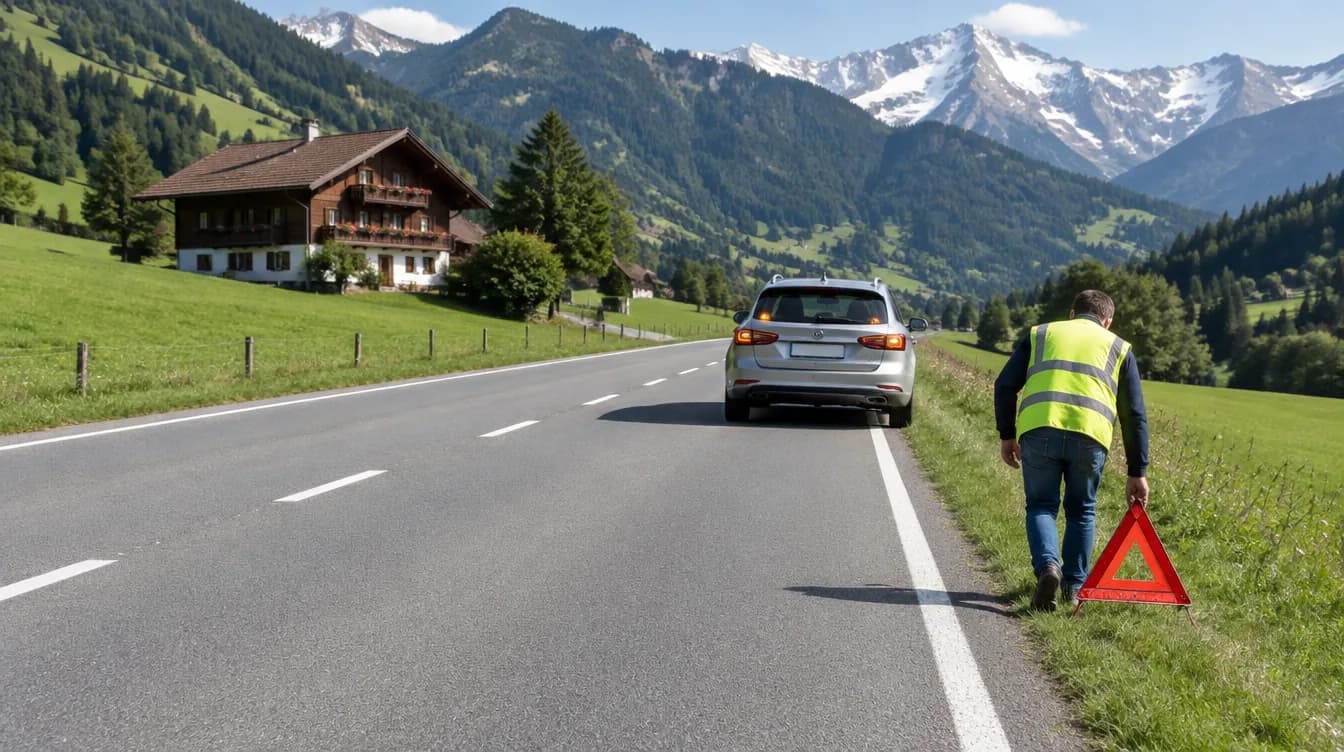
- If rail operations are obstructed, notify the railway immediately (Art. 54 para. 2 VRV); call the police (117) if a danger cannot be removed straight away.
Typical exam traps
- A closing half barrier means stop, even if part of the road is still open.
- No light at a St Andrew’s cross does not mean “clear”, it means “check yourself”.
- The overtaking ban applies on crossings without barriers; cyclists may still be overtaken when visibility is good.
- Stopping is banned on the crossing; parking already within 20 m.
- Red flashing lights appear only at level crossings and always mean stop.
How many questions to expect: How many questions are in the theory test? and the 2027 changes in Theory test 2027.
Practise level-crossing questions
Theorie Swiss has over 1,200 Swiss theory questions with explanations. Start with the free demo, practise via free online theory practice, or unlock 60 days for CHF 19.95. All basic rules: Swiss traffic rules; getting started: learn driving theory.
FAQ
When do I have to stop at a level crossing?
When barriers are closed or closing, a red flashing or red light is on, an acoustic signal sounds, or, where there are no barriers or signals, a train is approaching (Art. 28 SVG, Art. 93 para. 2 SSV).
What does a St Andrew’s cross without lights mean?
You must check for yourself that no rail vehicle is coming and the crossing is clear (Art. 93 para. 4 SSV).
May I overtake on a level crossing?
Not on crossings without barriers, except pedestrians, users of vehicle-like devices and cyclists when visibility is good (Art. 11 para. 3 VRV).
How close to a level crossing may I park?
Parking is prohibited closer than 20 m (Art. 19 para. 2 let. e VRV); voluntary stopping on the crossing itself is prohibited (Art. 18 para. 2 let. f VRV).
What if I am trapped between the barriers?
According to SBB: drive on and break through the barrier (it has a predetermined breaking point), then leave the crossing immediately.
What are the consequences of a violation?
Traffic rule violations are punished under Art. 90 SVG; depending on the danger caused and fault, a licence withdrawal may follow (Art. 16a–16c SVG). The sanction depends on the individual case.
Sources
- Road Traffic Act (SVG, SR 741.01): Art. 28; Art. 16a–16c, Art. 90
- Traffic Rules Ordinance (VRV, SR 741.11): Art. 4, 11, 17, 18, 19, 24, 54
- Signals Ordinance (SSV, SR 741.21): Art. 10, 68, 92, 93 (as of 1 October 2026)
- SBB: safe behaviour at stations, on trains and near tracks (level crossings)
Start free demo · Swiss traffic signs · Unlock 60 days · Order