Wildlife collision in Switzerland: what to do, reporting & insurance
Hit a deer? How to react to wild animals on the road, secure the scene, report the collision on 117 and what applies for fines and partial casco.
Quick answer: wildlife collision in Switzerland – what to do?
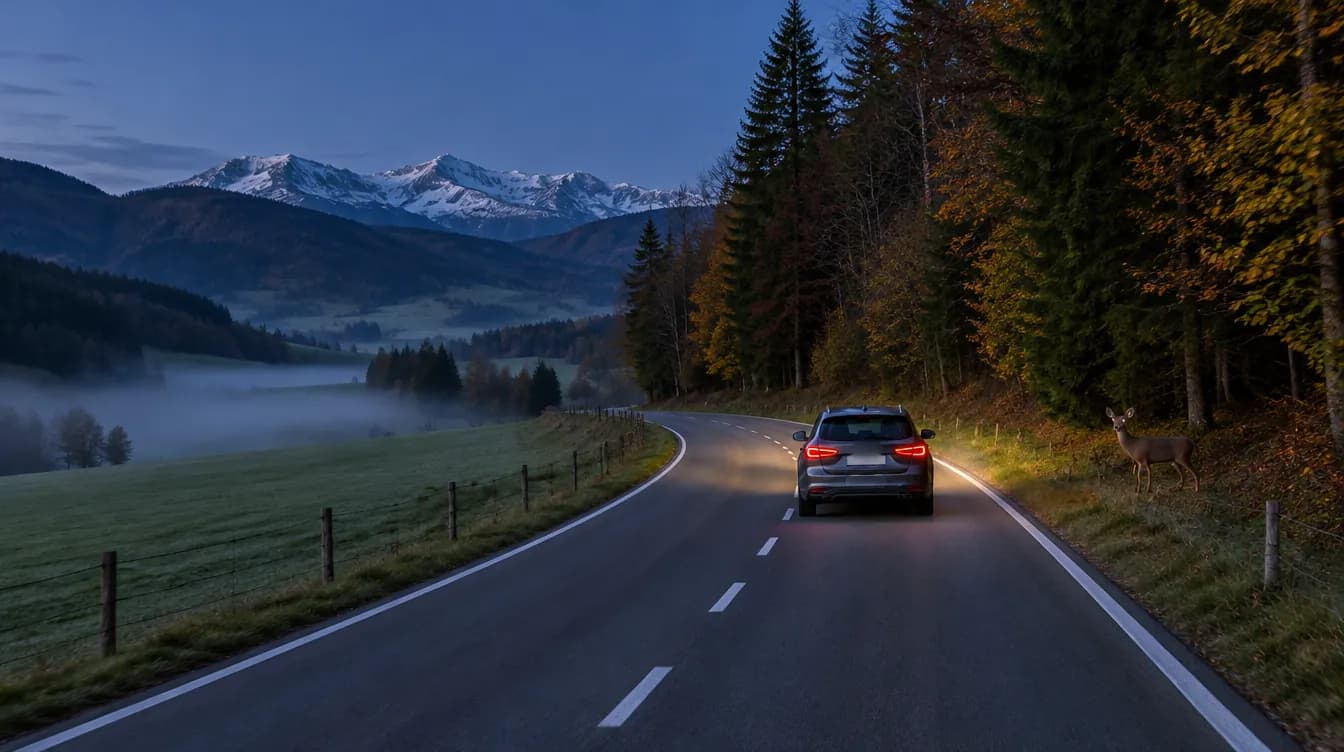
A roe deer, fox or badger suddenly appears in your headlights, and it has happened. After a collision with a wild animal (in German: Wildunfall), Switzerland expects a clear sequence:
- Stop and switch on the hazard lights.
- Secure the scene: put on a hi-vis vest, set up the warning triangle and get yourself out of the danger zone.
- Call the police on 117. The police alert the responsible game warden.
- Do not approach or touch the animal, even if it is injured.
- Wait for the police or the game warden. They take care of the animal and issue the confirmation for your insurer.
A wildlife collision must be reported, even if the animal ran off or your car looks barely damaged. Simply driving on is an offence (Art. 51 para. 3 and Art. 92 para. 1 SVG).
When and where wildlife collisions happen
According to the Swiss federal hunting statistics (kept on behalf of FOEN/BAFU), 7,651 roe deer were recorded as killed in road traffic in the 2025 hunting year. The cantonal police of Solothurn alone receive around 1,500 reports of collisions between motor vehicles and wild animals per year, mostly at night. Only reported and found animals are counted, so the real number is higher.
- Dawn, dusk and night: according to TCS, most collisions on wildlife-crossing stretches happen between 5 and 8 am and between 5 and 10 pm.
- Autumn and winter: after the clocks go back, rush hour falls into dusk, exactly when deer are active. In winter, animals also lick road salt at the roadside.
- Spring: animals look for fresh food and young animals explore.
- Forest and field edges: roads along woods, blind spots and cereal or maize fields close to the road.
The “wild animals” warning sign
The Swiss danger sign “Wildwechsel” (1.24) means you must expect wild animals on the road; the length of the danger zone is usually shown on an additional plate (Art. 12 para. 1 SSV). Outside built-up areas, danger signs normally stand 150 to 250 m before the hazard (Art. 3 para. 3 SSV). Do not confuse it with sign 1.25 “Animals”, which warns of unattended livestock such as cows. See our Swiss road signs overview for more danger signs.
The sign sets no specific speed, but the basic rule always applies: adapt your speed to the conditions and visibility (Art. 32 para. 1 SVG). General limits are explained in Speed limits in Switzerland.
Animal on the road: how to react
- Slow down and be ready to brake, especially in forests, at forest edges and at dusk.
- Watch the roadsides: animals’ eyes often reflect the headlights.
- Dip your high beam as soon as you see an animal. Bright light dazzles it and it often freezes.
- A short honk can help drive the animal off the road.
- Expect more animals: deer rarely come alone. Do not accelerate straight away once one has crossed.
- Keep enough distance so you can stop safely behind a braking vehicle. More in Safe following distance in Switzerland.
Collision unavoidable: brake, don’t swerve
If the impact can no longer be avoided: brake hard, hold the steering wheel firmly and stay in your lane. Avoid panic swerving. TCS crash tests showed that swerving can have far worse consequences than hitting the animal, for example ending up in oncoming traffic, in a ditch or against a tree. The safety of the people in the car comes first.
After the collision: step by step
- Stop, hazard lights on. After an accident involving a motor vehicle, everyone involved must stop immediately and secure traffic where possible (Art. 51 para. 1 SVG).
- Put on a hi-vis vest and set up the warning triangle. Where and how far is explained in Warning triangle in Switzerland. If an obstacle or other hazard arises, those involved must take safety measures at once (Art. 54 para. 1 VRV).
- Call 117 and describe the location as precisely as possible. The police contact the game warden.
- Keep away from the animal. An injured wild animal is stressed, unpredictable and will otherwise flee with its last strength.
- Wait for the police or game warden. If the animal fled, the warden can search for it with a trained dog, so the exact spot matters.
Taking the dead animal? No. Taking a dead wild animal is prohibited and counts as poaching under criminal law. The police or game warden decide when the animal is removed from the road.
Duty to report: what the law says
In road traffic law, wild animals are treated as property. If an accident causes only property damage, the person responsible must inform the injured party immediately; if that is not possible, they must notify the police without delay (Art. 51 para. 3 SVG). For wildlife this means in practice: call the police (117) immediately, who then alert the game warden. The Solothurn cantonal police explicitly ask drivers to report every collision, however minor.
- Not reported: anyone who breaches their duties after an accident is fined (Art. 92 para. 1 SVG). Reporting only later, for example when the insurer asks for a confirmation, is also an offence.
- Animal welfare: not reporting may prolong an injured animal’s suffering; according to TCS, a sanction under the Animal Welfare Act may follow as well.
- Noticed only later: if you realise afterwards that you were or may have been involved in an accident, you must return to the scene immediately or report to the nearest police station (Art. 56 para. 4 VRV).
- People injured: the stricter rules for injury accidents apply: give help and notify the police (Art. 51 para. 2 SVG). A driver who flees risks up to three years’ imprisonment or a monetary penalty (Art. 92 para. 2 SVG).
Insurance: who pays for the damage?
Damage from the direct collision with a wild animal is usually covered by partial casco (Teilkasko). Damage caused by swerving, for example against a tree or fence, is typically covered only by full casco (Vollkasko). Check your policy for the exact terms.
Your insurer needs proof: the game warden or police issue the accident report or wildlife-collision confirmation. Another reason to report immediately.
Typical theory-test traps
- “Swerving is safer than braking”: wrong. Braking, holding the wheel and staying in lane is usually safer.
- “The animal ran away, so I don’t need to report”: wrong. Call the police so the warden can search for it.
- “Use high beam to see deer better”: wrong. Dip your lights as soon as an animal is in the beam.
- “After the first deer the road is clear”: wrong. Expect more animals.
- “I may keep a dead deer”: wrong. That counts as poaching.
Practise the traffic rules
Danger signs, behaviour after accidents and adapted speed come up regularly in the theory test. See How many questions are in the theory test?, our guide to fog lights in Switzerland for poor visibility, the Swiss traffic rules page and, if needed, Failed the theory test. Start with the free demo, read how to study for the theory test online, or unlock all questions on the pricing page.
FAQ
What do I do after hitting a deer in Switzerland?
Stop, hazard lights on, put on a hi-vis vest, secure the scene with the warning triangle, call the police on 117, keep away from the animal and wait for the police or game warden.
Do I have to report a wildlife collision?
Yes. Under Art. 51 para. 3 SVG you must inform the injured party or, if that is not possible, the police without delay. For wild animals: call 117 straight away, even for small animals and even if the animal fled.
What happens if I don’t report it?
Breaching your duties after an accident is punished with a fine (Art. 92 para. 1 SVG); late reporting is also an offence. A sanction under animal welfare law may follow too.
Does insurance pay for a wildlife collision?
Damage from the direct impact is usually covered by partial casco; damage from swerving typically only by full casco. The police or game-warden report serves as proof.
Should I swerve to avoid a deer?
No. Brake in a controlled way, hold the wheel firmly and stay in your lane.
Sources
- Road Traffic Act (SVG, SR 741.01): Art. 32, 51, 92; Traffic Rules Ordinance (VRV, SR 741.11): Art. 54, 56
- Road Signs Ordinance (SSV, SR 741.21): Art. 3 and 12 (sign 1.24 “Wildwechsel”)
- Canton of Solothurn (Office for Forests, Hunting and Fisheries; cantonal police), Zurich cantonal police, Zug police: behaviour after wildlife collisions
- TCS: wildlife collisions – what next?; wild animals on the road – what to do?
- Swiss federal hunting statistics (FOEN/BAFU, Wildtier Schweiz), hunting year 2025
Note: Not legal advice; the applicable legislation, cantonal practice and the individual case are decisive.
Start free demo · Swiss traffic rules · Unlock 60 days · Order