Headlight rules in Switzerland: lights on by day, low beam & high beam
Daytime running lights or low beam? Which lights Swiss law requires when, when to dip your high beam, what applies in tunnels and the fines for driving without lights.
Quick answer: what are the headlight rules in Switzerland?
In Switzerland you drive a motor vehicle with lights on at all times, even in bright sunshine. Since 1 January 2014, motor vehicles must always be lit while driving (Art. 41 para. 1 SVG). Which light you need depends on the situation:
- Daytime with good visibility: daytime running lights or dipped headlights (Art. 30 para. 2 VRV).
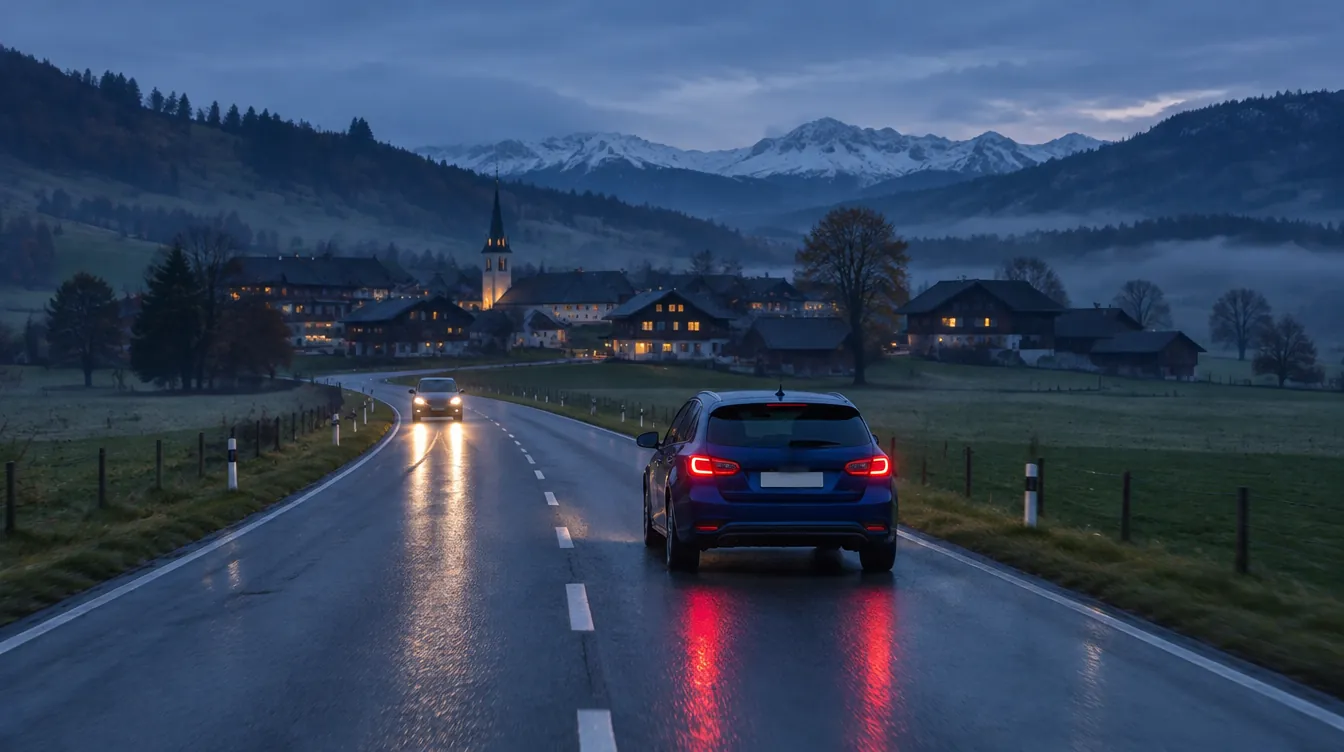
- From dusk until full daylight, in poor visibility and in tunnels: dipped headlights (low beam) (Art. 30 para. 1 VRV). Daytime running lights are not enough.
- High beam: only when needed, avoided in built-up areas where possible, and dipped in good time (Art. 30 para. 3 VRV).
- Fog lights and rear fog light: only when visibility is considerably reduced by fog, driving snow or heavy rain (Art. 30 para. 4 VRV).
Driving without lights during the day costs a fixed fine of CHF 40. Right now, in autumn and winter when it gets dark early, the rules are worth a closer look. (In German the topic is called Lichtpflicht or Licht am Tag.)
Lights during the day: daytime running lights or low beam?
During the day you can choose: daytime running lights or dipped headlights. Both meet the requirement, but the difference matters:
- Daytime running lights are designed so that you are seen. They are at the front only, weaker than dipped headlights and usually work without the tail lights. On most newer cars they switch on automatically when you start the engine.
- Dipped headlights are designed so that you can see. They light up the road, and the tail lights come on at the back.
If your car has no daytime running lights, you must drive with dipped headlights during the day. The TCS recommends simply leaving the light switch on low beam.
There are only a few exemptions from the daytime light rule (Art. 30 para. 2 VRV, since 1 April 2022):
- motor vehicles steered by a person on foot (for example a single-axle tractor),
- motor vehicles with a maximum speed of up to 10 km/h,
- motor vehicles first registered before 1 January 1970 (classic cars).
E-bikes count as motor vehicles too: according to the BFU (Swiss Council for Accident Prevention) they must also ride with lights on during the day, whether slow or fast e-bike. Ordinary bicycles without a motor only need lights from dusk until full daylight and in poor visibility (Art. 41 para. 1 SVG).
When dipped headlights are mandatory
You must switch on your dipped headlights (Art. 30 para. 1 VRV):
- from the start of dusk until full daylight, so in the morning twilight too,
- in poor visibility, for example in rain, snowfall or fog,
- in tunnels, even during the day and even in well-lit tunnels. In tunnels vehicles must always be lit (Art. 39 para. 2 VRV).
The reason: daytime running lights are too weak and mostly work without tail lights. At dusk or in the rain the driver behind you can barely see you, even though “something is on” at the front. A typical winter situation: you set off in the dark in the morning, the dashboard is brightly lit, and you don’t notice that the back of your car is completely dark.
Careful with automatic lights: don’t rely blindly on the light sensor. The Bern cantonal police point out that sensors often react too late to poor light conditions. When in doubt, switch on the dipped headlights yourself and check that the switch really is set to “Auto”.
High beam: when to use it and when to dip
You may use high beam when needed, typically at night on unlit roads outside built-up areas. In built-up areas you avoid it where possible. You must switch off the high beam (Art. 30 para. 3 VRV):
- in good time before meeting other road users, i.e. oncoming traffic but also cyclists or pedestrians,
- before an oncoming train running alongside the road,
- when following another vehicle,
- when reversing.
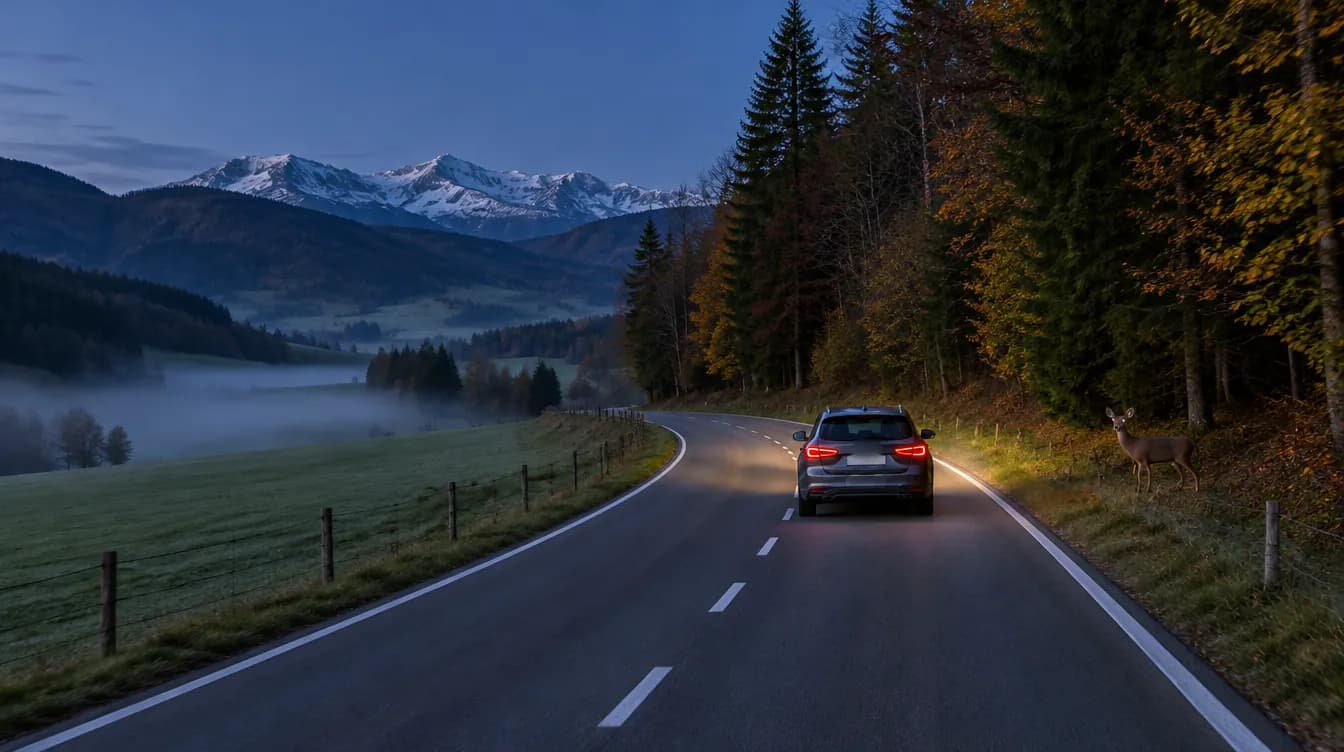
Behind this is the basic rule that lights must be used so that nobody is dazzled unnecessarily (Art. 41 para. 4 SVG). If you see wild animals on the road, dip your lights immediately so the animal doesn’t freeze in the beam. More in Wildlife collision in Switzerland.
Flash, don’t honk, at night: after dark only light signals are allowed; the horn is for emergencies only (Art. 29 para. 3 VRV). Warning signals are only given where safety requires it anyway (Art. 29 para. 1 VRV).
Fog lights, parking lights and lights when parked
- Fog lights and the rear fog light do not replace dipped headlights. You may only use them when visibility is considerably reduced by fog, driving snow or heavy rain. The details are in Fog lights in Switzerland.
- Parking lights (side lights) are for stationary vehicles only. During a longer stop you may switch from dipped headlights to parking lights (Art. 30 para. 5 VRV). Driving on parking lights is not allowed.
- Parked vehicles: motor vehicles must be lit from dusk until full daylight and in poor visibility, except in car parks or where street lighting is sufficient (Art. 41 para. 2 SVG). Outside built-up areas, parked multi-track vehicles need the parking lights or the parking light on the traffic side; inside built-up areas reflectors are enough (Art. 31 VRV). Where you may stop and park at all is explained in Stopping and parking in Switzerland.
- Colours: no red lights or reflectors to the front and no white ones to the rear (Art. 41 para. 3 SVG). The Federal Council may allow exceptions.
Don’t confuse the two: traffic lights at junctions are called Lichtsignale in Switzerland. They are about red, amber and green; this article is about the lights on your vehicle.
Fines: how much does driving without lights cost?
The Fixed Penalties Ordinance (OBV, Annex 1, items 323 and 324) sets these amounts for motor vehicles:
- driving without lights during the day: CHF 40
- driving without lights at night on a lit road: CHF 60
- driving without lights in a lit tunnel: CHF 60
- driving on parking lights or daytime running lights at night on a lit road or in a lit tunnel: CHF 40 each
- improper use of fog lights or the rear fog light: CHF 40 each (item 325)
Cases not on this fixed-penalty list, for example driving without lights at night on an unlit road and endangering others, are not settled with a fixed fine but assessed in ordinary proceedings.
Winter light check
Good lights only help if they are clean and working. The BFU recommends keeping your headlights clean and regularly checking that all lights still work. In practice:
- Before driving, remove snow, ice and dirt from headlights and tail lights.
- Walk around the car now and then: are the dipped headlights, tail lights, brake lights and indicators working?
- In rain, snow or at dusk, switch to dipped headlights yourself early.
Suitable tyres are part of winter equipment too. What applies is covered in Winter tyres in Switzerland.
Typical theory test traps on lights
- “In sunshine I don’t need lights”: Wrong. Motor vehicles in Switzerland drive with lights during the day too, at least with daytime running lights.
- “Daytime running lights are enough in a tunnel”: Wrong. Dipped headlights are mandatory in tunnels, even during the day.
- “At dusk daytime running lights are fine, something is on at the front”: Wrong. From dusk you need dipped headlights, because daytime running lights usually work without tail lights.
- “I can keep high beam on behind another car as long as nothing is coming”: Wrong. When following another vehicle you switch off the high beam.
- “Fog lights always make sense in daytime rain”: Wrong. Only when visibility is considerably reduced; otherwise it is improper use.
- “Bicycles need lights during the day too”: Not ordinary bicycles. But e-bikes are motor vehicles and ride with lights during the day.
Practise the light rules
Questions on dipped headlights, high beam and fog lights come up regularly in the theory test. So test yourself on situations like dusk, tunnels and oncoming traffic. How many questions to expect is explained in How many questions are in the theory test?. An overview of all key rules is on Swiss traffic rules.
Knowledge sticks fastest when you answer real exam-style questions. Start with the free demo or read how to learn the theory test online for free. If you want every question with explanations, unlock access on the pricing page.
FAQ
Do I have to drive with lights on during the day in Switzerland?
Yes. Since 1 January 2014 motor vehicles must always be lit while driving. During the day with good visibility daytime running lights are enough; otherwise use dipped headlights.
Are daytime running lights enough in Switzerland?
During the day with good visibility, yes. From dusk until full daylight, in poor visibility and in tunnels you need dipped headlights (Art. 30 para. 1 VRV).
What is the fine for driving without lights in Switzerland?
CHF 40 during the day, CHF 60 at night on a lit road or in a lit tunnel. Driving there on parking lights or daytime running lights only costs CHF 40.
When do I have to switch off the high beam?
In good time before meeting other road users or an oncoming train alongside the road, when following another vehicle and when reversing. In built-up areas you avoid it where possible.
Do classic cars have to use lights during the day?
Not if they were first registered before 1 January 1970. At dusk, in poor visibility and in tunnels the light rules apply to them as well.
Does the light rule apply to e-bikes?
Yes. E-bikes are motor vehicles and, according to the BFU, must also ride with lights on during the day. Ordinary bicycles only need lights from dusk until full daylight and in poor visibility.
Sources
- Road Traffic Act (SVG, SR 741.01): Art. 41
- Traffic Rules Ordinance (VRV, SR 741.11): Art. 29, 30, 31 and 39
- Fixed Penalties Ordinance (OBV, SR 314.11): Annex 1, items 323 to 325
- BFU: driving with lights during the day; being visible on the road
- TCS: lights during the day – daytime running lights or dipped headlights?
- Solothurn cantonal police: vehicle lights; Bern cantonal police: the right light in every situation
Note: Not legal advice; the applicable legislation, cantonal practice and the individual case are decisive.
Start free demo · Swiss traffic rules · Unlock 60 days · Order