Child seats & seat belts in Switzerland: rules for the theory test
Child seats in Switzerland for the theory test: mandatory under 12 and 150 cm, seat belts in every seat, exceptions, airbag rules and typical traps.
Short answer — what are the child seat and seat belt rules in Switzerland?
For child seats in Switzerland and the Swiss seat belt law, the theory test mainly checks three things: who must buckle up, when a child needs a child seat, and who is responsible. The short version, based on Art. 3a of the Traffic Rules Ordinance (VRV):
- Seat belt obligation: in vehicles fitted with seat belts, the driver and every passenger must wear the belts during the journey — front and rear (VRV Art. 3a para. 1).
- Child seat obligation: children under 12 years who are shorter than 150 cm need a suitable, approved child restraint, for example a child seat or booster seat (VRV Art. 3a para. 4).
- Responsibility: the driver is responsible for children under 12. Anyone aged 12 or over is responsible for their own belt.
- Front passenger seat: children may in principle ride in the front — but rear-facing seats only with the airbag deactivated (ASTRA).
- Approved seats: only those meeting UN ECE Regulation No. 44 (series 03/04) or No. 129; since 1 September 2024 only No. 129 seats may be sold new (ASTRA).
For an overview of all basic rules, see Swiss traffic rules. This article stays exam-focused on duties, exceptions and typical traps — without a fines table.
Note: compiled from the VRV, ASTRA and the BFU legal FAQs. Not legal advice and no substitute for official information — if in doubt, ask your cantonal road traffic office.
Seat belt obligation: who, when and in which seats?
The rule is deliberately simple: where a seat belt is fitted, it must be worn. That applies to the driver, to the front passenger and to everyone in the rear seats. According to the BFU, the obligation also applies in taxis and coaches. In buses and minibuses, passengers must also be made aware of the seat belt obligation in a suitable way (VRV Art. 3a para. 3).
The phrase «during the journey» matters for the exam. The Federal Supreme Court ruled that it covers the whole time you take part in traffic — including stopping because of traffic. So if you briefly unbuckle at a red light to grab something from the glovebox, you breach the seat belt rule (BGE 137 IV 290, as cited by the BFU). Only a stop in a parking or lay-by area ends the journey. More on the difference between stopping and parking: Stopping and parking in Switzerland.
Exceptions to the seat belt obligation
VRV Art. 3a para. 2 lists exactly who does not have to wear a belt. It pays to know this list, because exam questions like to use «always» or «never»:
- People with a medical certificate stating that wearing a seat belt cannot reasonably be expected of them.
- House-to-house delivery drivers in their delivery area, if not driving faster than 25 km/h.
- Journeys on field and forest tracks and on works premises up to 25 km/h.
- The driver when manoeuvring at walking pace — for example while parking.
- Drivers and passengers of motor vehicles in regional scheduled services of licensed transport companies, such as the PostBus.
- Escorts of people requiring special care in ambulances and disability transport services.
- Drivers and passengers of working vehicles, tractors and motor carts up to 25 km/h.
Remember the difference: the PostBus on a scheduled route is exempt, a taxi and a coach are not. The BFU still recommends always wearing a seat belt if one is fitted.
Wearing the belt correctly
A belt only protects if it sits snugly against the body. The shoulder belt runs over the shoulder and chest, the lap belt low across the pelvis — not over the stomach. The BFU cites a ruling in which a belt loosened with a clip sat so slack that it counted as not worn (ruling 6S.41/2007). Thick winter jackets — especially on children — should be opened or taken off so the belt fits tightly.
Child seat Switzerland: when is it mandatory?
Adult seat belts are designed for adults and do not protect children sufficiently in a crash. That is why VRV Art. 3a para. 4 requires that, in seats with seat belts, a suitable child restraint must be used for children under 12 — unless the child is already at least 150 cm tall. So whichever comes first counts: the 12th birthday or a height of 150 cm. This up-to-12 rule has applied since 1 April 2010 (BFU).
| Situation | Required restraint |
|---|---|
| Child under 12 and shorter than 150 cm | Suitable child restraint (infant carrier, child seat, booster seat) |
| Child of 150 cm or taller (even under 12) | Fitted seat belt |
| Person aged 12 or over | Fitted seat belt |
| Child aged 4 or over on a «child seating position» listed in the vehicle registration, or in a coach | Fitted belt is sufficient |
| Child aged 7 or over on a seat with a lap belt (2-point belt) | Fitted belt is sufficient |
Source of the table: VRV Art. 3a para. 4 and the ASTRA fact sheet on securing children. In public transport vehicles (regional scheduled services), child seats and belts can be dispensed with entirely; the same applies with a medical certificate (BFU, VRV Art. 3a para. 2).
Which child seats are allowed?
Approved child restraints are those meeting series 03 or 04 of UN ECE Regulation No. 44 or UN ECE Regulation No. 129. You can recognise them by the orange approval label on the seat (BFU). Since 1 September 2024, only seats meeting Regulation No. 129 may be sold new, because they meet higher requirements, including in side impacts. Regulation No. 44 seats bought before that date may still be used (ASTRA).
Infant carrier, child seat or booster?
The right restraint depends on height, weight and age. The BFU roughly groups them like this:
- Infant carrier (up to about 1½ years): always fitted rear-facing, ideally on the rear seat.
- Child seat (about 1½ to 4 years): firmly attached to the car; with Isofix, check that the seat is approved for the car.
- Booster seat (about 4 to 12 years or up to 150 cm): ideally with a backrest. A simple booster cushion without a backrest is allowed but gives no protection in a side impact.
Move up only when the child’s head sticks out above the carrier or seat. According to the BFU, the Isofix connector has been mandatory on new cars since 2014 and makes fitting easier and more stable.
Child in the front passenger seat: what about the airbag?
A common myth: «Children are not allowed in the front.» That is not correct. According to ASTRA, children of any age may in principle ride in the front passenger seat if they are properly secured. The airbag is what matters:
- Rear-facing seats (infant carrier, reboard seat) on a seat with a front airbag only if the airbag is deactivated.
- Forward-facing seats may be used on seats with an airbag if the vehicle manufacturer’s manual does not rule it out.
The BFU still recommends the rear seat as the safest place — for older children too. And: you may only carry as many people as there are seats entered in the vehicle registration document (field 27, BFU). An «extra» child on someone’s lap is not an option.
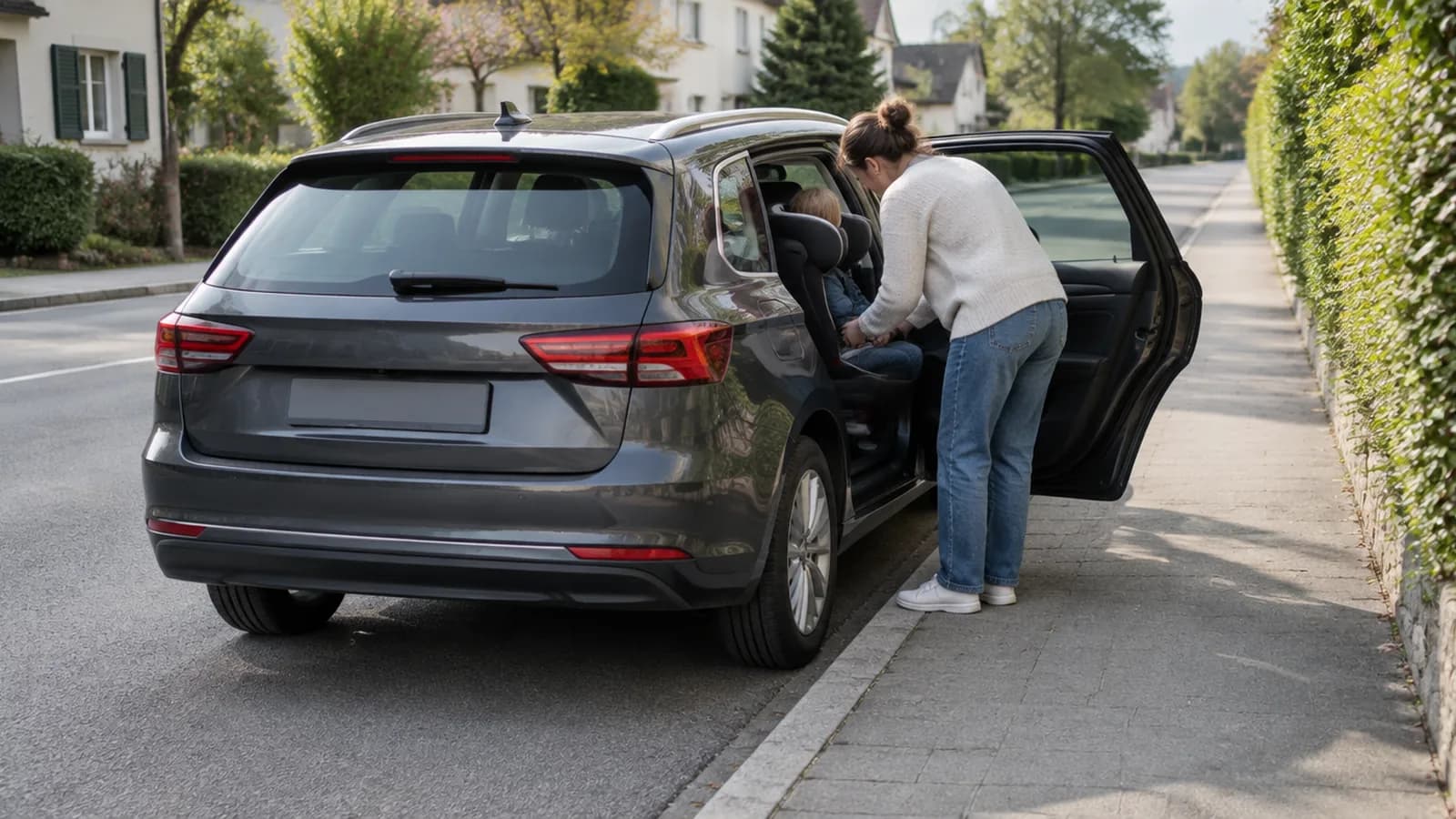
A practical safety tip: let children get in and out on the pavement side. In Swiss right-hand traffic, when you park at the right-hand edge of the road, that is the right side of the car — away from moving traffic.
Who is responsible — and what are the consequences?
VRV Art. 3a para. 1 splits responsibility clearly: everyone aged 12 or over must buckle up themselves. For children under 12, the driver must make sure they are properly secured. Anyone not wearing a belt can be fined personally; so can a driver carrying a child who is not properly secured (BFU). For the exam it is enough to know that fines apply — you do not need to memorise amounts.
More important than the fine are the consequences in a crash: according to the BFU, not wearing a belt counts as gross negligence, and insurance benefits such as daily allowances can be reduced. Physics adds to the risk: the higher the speed, the greater the impact energy — see Speed limits in Switzerland.
On responsibility, learner drives are worth a look: the accompanying person and the learner must both be buckled up. The steps are in learner permit. Which other duties apply to learners and new drivers is covered in Drink-driving limit Switzerland.
Typical theory test traps
- «You don’t have to buckle up in the back.» Wrong — the obligation applies to every seat with a belt.
- «I may briefly unbuckle while waiting at a red light.» Wrong — stopping because of traffic is part of the journey.
- «A 10-year-old who is 152 cm tall needs a booster seat.» Wrong — from 150 cm the normal belt is enough, even under 12.
- «An 11-year-old who is 140 cm tall may ride without a booster.» Wrong — under 12 and under 150 cm, a child restraint is mandatory.
- «Children may never sit in the front passenger seat.» Wrong — allowed if properly secured; rear-facing only with the airbag deactivated.
- «The father sitting next to the child in the back is responsible for it.» Wrong — the person driving the vehicle is responsible.
- «There is no seat belt obligation in a taxi.» Wrong — only regional scheduled services such as the PostBus are exempt.
Many more questions on safety equipment such as the warning triangle, lights and tyres are covered in Vehicle basics for the theory test.
Since when has the seat belt obligation applied in Switzerland?
Compulsory seat belts were narrowly approved in a popular vote on 30 November 1980 (51.55 % yes, Swissvotes) and have applied since 1 July 1981 — initially for the front seats. The obligation for rear seats followed in 1994, and for coach passengers in 1999 (NZZ). Today’s child seat rule up to the 12th birthday has applied since 1 April 2010. You don’t need to know these years for the exam — but you do need to know the current rules.
Practise seat belt and child seat questions online for free
The rules are short, but exam questions are often tricky: age or height, front or rear, taxi or PostBus. Knowledge sticks fastest when you run through typical situations repeatedly. Start with practise the theory test online for free or try the demo. For complete training on all topics, go to learn driving theory and see the pricing.
FAQ
Until what age does a child need a child seat in Switzerland?
Until the 12th birthday — unless the child is already at least 150 cm tall. Whichever comes first ends the child seat obligation (VRV Art. 3a para. 4).
Does the seat belt obligation apply in the back seat too?
Yes. In every seat with a seat belt, the driver and passengers must wear the belt during the journey.
Can children sit in the front in Switzerland?
Yes, at any age, if they are properly secured. Rear-facing child seats only with the front airbag deactivated; the rear seat is recommended.
Which child seats are approved in Switzerland?
Seats meeting UN ECE Regulation No. 44 (series 03/04) or No. 129. Since 1 September 2024 only No. 129 seats may be sold new; older R44 seats may still be used.
Who is responsible if a child is not buckled up?
For children under 12, the person driving the vehicle. From 12, everyone is responsible for their own belt.
Do I have to wear a belt while parking?
When manoeuvring at walking pace, the driver is exempt from the seat belt obligation (VRV Art. 3a para. 2 let. d). It applies fully for the rest of the journey.
Do you have to buckle up on the PostBus?
Not in regional scheduled services — but the BFU still recommends wearing any belts fitted. In taxis and coaches the obligation applies.