Drink-driving limit Switzerland: 0.5‰, 0.1‰ for new drivers & theory
Swiss drink-driving limits for the theory exam: 0.5‰ general, 0.1‰ for learners and new drivers, 0.8‰ qualified, BAC vs breath — clear traps.
Short answer — what drink-driving limit applies in Switzerland?
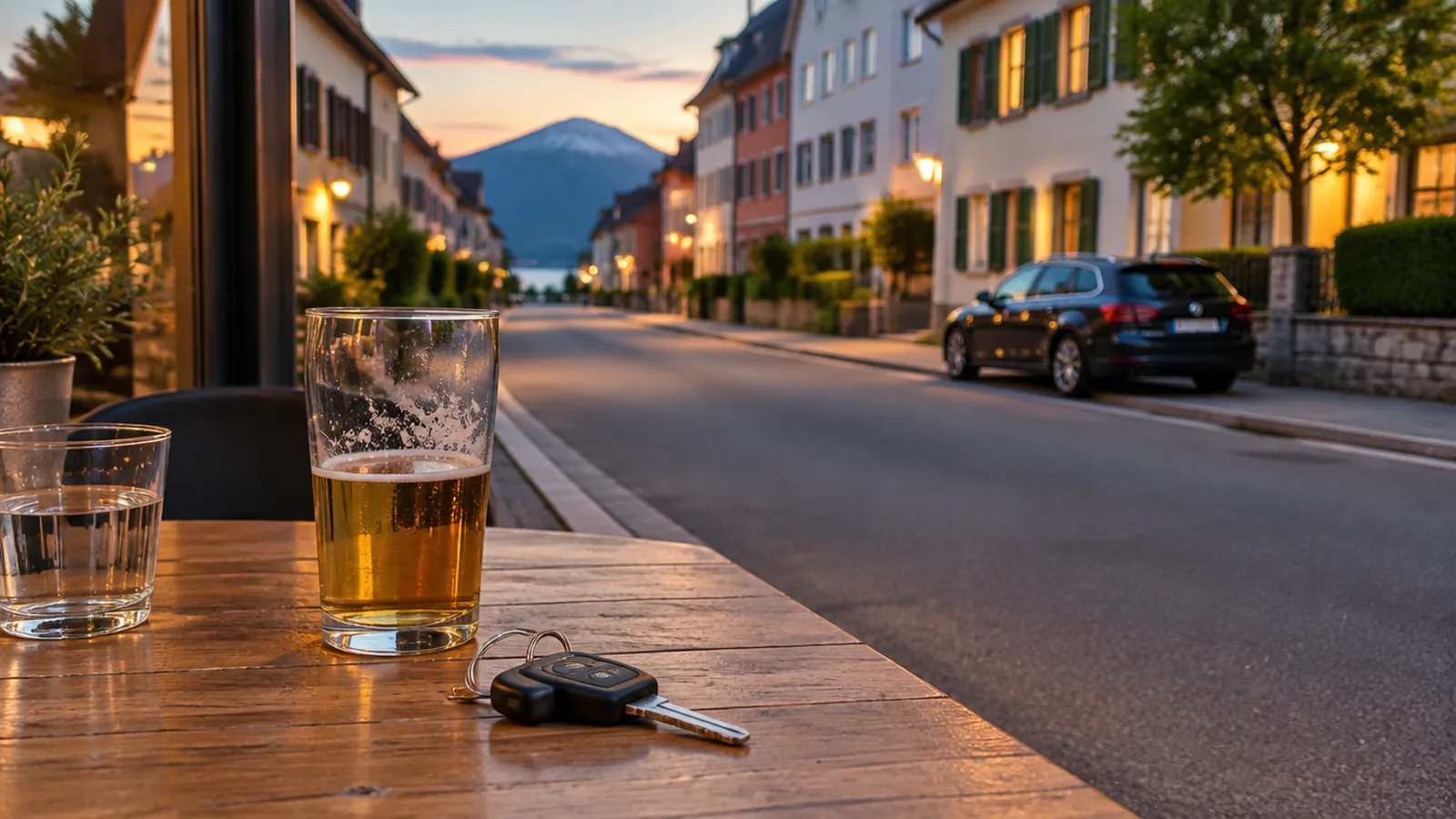
For the drink-driving limit in Switzerland, the theory exam mainly tests thresholds and who they apply to: In general, from 0.5‰ blood alcohol (BAC) or 0.25 mg/l breath alcohol (BrAC) you are considered under the influence. For learner drivers, accompanying persons, the probationary licence and certain professional groups there is a de-facto alcohol ban from 0.1‰ / 0.05 mg/l. From 0.8‰ / 0.4 mg/l the concentration is “qualified” (aggravated). And: unfitness to drive can exist even below 0.5‰.
- General: 0.5‰ BAC / 0.25 mg/l BrAC = under the influence (SR 741.13 Art. 1).
- Alcohol-ban groups: 0.1‰ / 0.05 mg/l — learners, accompanying person, probation and professional groups (VRV Art. 2a).
- Qualified: from 0.8‰ / 0.4 mg/l (SR 741.13 Art. 2) — a clearly more serious offence.
- Unfit to drive: possible even below 0.5‰ (SVG Art. 31 para. 2) — the number is not a free pass.
- Right-hand traffic (RHT): All examples assume Swiss right-hand traffic.
Rules hub: Swiss traffic rules. This article stays exam-focused on limits and situations — focus on the exam situation, not fine amounts.
Note: Framing follows syllabus / VRV / SVG logic and BFU legal Q&A. Not legal advice and not a substitute for official guidance — if in doubt, ask the road traffic office.
Exam-wise what counts is the mapping: who is driving, which limit applies, and whether the person is still fit to drive despite the number. Many learners only remember “0.5 per mille” and miss the 0.1‰ alcohol ban and unfitness below the general limit. This deep-dive owns exactly those patterns — limits, groups, BAC vs BrAC and typical traps — without drifting into sanction catalogues.
The three limits at a glance (0.1 · 0.5 · 0.8 per mille)
For the Swiss alcohol limit, memorise three value pairs: blood alcohol in per mille (‰) and breath alcohol in milligrams per litre (mg/l). The exam often asks both units — and who has which limit.
| Level | BAC (‰) | BrAC (mg/l) | Who |
|---|---|---|---|
| Alcohol ban | 0.1 | 0.05 | Learners, accompanying person, probation (except F/G/M), professional groups (VRV Art. 2a) |
| Under the influence | 0.5 | 0.25 | Vehicle drivers in general (SR 741.13 Art. 1) |
| Qualified | 0.8 | 0.4 | Vehicle drivers — more serious offence (SR 741.13 Art. 2) |
The table lists limits only — no sanctions in francs. That keeps the focus on what the theory exam tests.
Blood alcohol (BAC) vs breath alcohol (BrAC)
BAC measures alcohol in blood in per mille (‰). BrAC measures alcohol in breath in mg/l. Since 1 October 2016 the breath test is the usual means of proof (BFU) — the limit values themselves stayed unchanged. Exam mnemonic: 0.25 mg/l ≙ 0.5‰ and 0.4 mg/l ≙ 0.8‰; for alcohol-ban groups 0.05 mg/l ≙ 0.1‰.
Under the influence vs qualified
Under the influence starts at 0.5‰ / 0.25 mg/l. Qualified from 0.8‰ / 0.4 mg/l means, in exam logic, a clearly more serious offence — without listing fine or withdrawal-duration tables here. Remember the steps: ban (0.1) → under the influence (0.5) → qualified (0.8).
0.1 per mille: who does the alcohol ban apply to?
Since 1 January 2014 (Via Sicura), VRV Art. 2a sets an alcohol ban from 0.1‰ BAC or 0.05 mg/l BrAC for clearly defined groups. Often asked in the exam — and often confused with the general 0.5 limit.
- Learner and practice drives
- Accompanying persons on learner drives (classic exam trap)
- Probationary licence — except special categories F, G, M
- Driving instructors on duty
- Professional passenger transport
- Lorries, heavy articulated vehicles and tractors over 3.5 t
- Dangerous-goods transport
- Licensed and cross-border passenger transport
For these groups the practical rule is: no alcohol when driving — the 0.1 limit is so low that “one drink” does not mean “still allowed” in exam logic.
New drivers with a probationary licence
The probation period lasts three years (SVG Art. 15a). During that time the 0.1‰ alcohol ban applies (except categories F, G, M). If the licence is withdrawn for a medium or serious offence, probation is extended by one year; a second such offence means the licence lapses. We stop there — more in Swiss probationary licence.
Learner permit and accompanying person
On learner drives the alcohol ban applies to the learner and the accompanying person. “I’m only sitting beside them, one beer is fine” is a typical trap. Context on learner permits and categories: Learn driving theory — car, motorcycle, moped.
Unfit to drive even below 0.5 per mille
SVG Art. 31 para. 2 is clear: anyone who is unfit to drive because of alcohol, narcotics, medication or other reasons (e.g. fatigue) must not drive a vehicle. So the 0.5 limit is not a free pass for “still 0.4, so all good”.
Alcohol slows reactions — reaction distance and thus stopping distance get longer. Soft bridge on distance: Safety distance Switzerland. Soft bridge on speed and stopping distance: Speed limits Switzerland. Neither article is rewritten here — only the link matters: less fit → more distance, less speed.
Drugs and medication: zero tolerance
For certain narcotics there is zero tolerance: detection of THC, cocaine, free morphine, amphetamine, methamphetamine, MDEA or MDMA means proven unfitness under VRV Art. 2 para. 2 (exception: medically prescribed use proven). For medication, the package leaflet and medical advice count — if unsure, do not drive. Short and exam-wise: drugs ≠ “still OK under the alcohol limit”.
Bike, e-bike, moped — does the limit apply here too?
Unfitness to drive applies to all vehicle drivers (SVG Art. 31 para. 2). The 0.5‰ under-the-influence threshold applies to vehicle drivers (SR 741.13 Art. 1) — not only to car drivers.
Per BFU: bicycles, kick scooters and slow e-bikes (up to 25 km/h) are non-motor vehicles; fast e-bikes (up to 45 km/h) and mopeds are motor vehicles. The 0.1‰ rule for probationary licence holders does not apply to special categories F, G and M (M = moped) — memorise exactly that, without further speculation. Practise moped theory: Learn moped theory test free.
Police check: breath test even without suspicion
Police may subject vehicle drivers and persons involved in an accident to a breath alcohol test even without concrete suspicion (SVG Art. 55 para. 1). Qualitative consequences, without franc amounts: further driving can be prevented; the licence can be taken immediately (SVG Art. 54 para. 3). From 1.6‰ BAC or 0.8 mg/l BrAC a fitness-to-drive assessment may follow (SVG Art. 15d).
Phone use while driving is a separate exam topic and only mentioned briefly here — distraction and alcohol both relate to fitness to drive, but phone detail rules belong in their own post. Note: Not legal advice; concrete cases are for the competent authority.
Typical theory-exam traps
No original exam questions and no copied tasks — only exam-style patterns on the Swiss drink-driving limit and alcohol at the wheel:
- “0.5‰ applies to everyone.” — Wrong for learners, accompanying persons, probation and the professional groups under VRV Art. 2a (0.1‰).
- “The accompanying person may drink.” — Wrong. The accompanying person is also under the alcohol ban on learner drives.
- “Below 0.5‰ I am always fit to drive.” — Wrong. SVG Art. 31 para. 2: unfitness possible below that too.
- “Coffee, food or fresh air quickly lowers the level.” — Wrong. Only time reduces alcohol; no per-hour burn-off figures and no BAC calculator here.
- “Morning-after residual alcohol does not count.” — Trap. Next morning the level can still be over the limit — especially critical for 0.1 groups.
- “Confusing breath and blood values.” — 0.25 mg/l BrAC equals 0.5‰ BAC; 0.05 mg/l equals 0.1‰. Do not mix units.
Since when has 0.5‰ applied — and was the limit abolished?
The general 0.5‰ limit has applied since early 2005 (previously 0.8‰). The 0.1‰ alcohol ban for the listed groups has applied since 1 January 2014 (Via Sicura, VRV Art. 2a). The drink-driving limit was not abolished — 2026 discussions did not repeal the road-traffic threshold. Exam-wise: 0.5 since 2005, 0.1 since 2014, both still apply.
How to practise alcohol and fitness questions online for free
Many errors come from reading “0.5 for everyone” instead of “who has which limit?” and from forgetting unfitness below the number. Practice goal: stable patterns — group? BAC or BrAC? Under the influence or qualified? Still fit?
- Start with the demo and filter questions on alcohol, fitness and learner drives.
- Practise mixed sets under learn theory test online free.
- Move to full simulations via learn driving theory.
- Optional before the exam: theory exam study plan.
- Light upsell if needed: packages & prices.
Note: Organisational details can vary by canton. If in doubt, ask the competent road traffic office — this article does not replace official guidance and is not legal advice.
FAQ
What drink-driving limit applies in Switzerland?
Generally 0.5‰ BAC / 0.25 mg/l BrAC (under the influence). For certain groups 0.1‰ / 0.05 mg/l. Qualified from 0.8‰ / 0.4 mg/l. Overview: Swiss traffic rules.
How much may new drivers have?
Practically zero: alcohol ban from 0.1‰ / 0.05 mg/l during probation (except special categories F, G, M).
Does the 0.1‰ limit also apply to accompanying persons on learner drives?
Yes (VRV Art. 2a para. 1 lit. g) — accompanying person and learner alike.
What does qualified alcohol concentration mean?
From 0.8‰ / 0.4 mg/l — in exam logic a clearly more serious offence than “only” under the influence.
May I drive with 0.3‰?
Only if no alcohol ban (0.1) applies and you are fit to drive. Unfitness can exist even below 0.5‰ (SVG Art. 31 para. 2).
Does the limit also apply on a bicycle?
Yes: unfitness and the 0.5‰ under-the-influence rule apply to vehicle drivers — including non-motor vehicles.
Was the Swiss drink-driving limit abolished?
No. 0.5‰ since 2005, 0.1‰ ban since 2014 — both still apply.
Ready to solve alcohol and fitness questions calmly?
Memorise three values (0.1 / 0.5 / 0.8), do not confuse BAC and BrAC, know the alcohol-ban groups, take unfitness below 0.5 seriously — that is the exam core for the Swiss drink-driving limit. Link with Swiss traffic rules, safety distance and speed limits, and practise situation pictures. Stable judgement under time pressure saves error points — and in daily life the same pattern protects you and others.
Practise free online · Start demo · Choose a package · Order