Winter tyres Switzerland: obligation, tread depth, snow chains & theory
Swiss winter tyres for the theory exam: obligation myth, tread depth, snow chains, all-season tyres and typical traps – clear and practise-ready.
Short answer — is there a winter-tyre obligation in Switzerland?
For winter tyres in Switzerland, the theory exam mainly tests situational judgement: Is there a fixed calendar obligation as often assumed from AT/DE – or does it count that tyres are adapted to the conditions? Many confuse recommendations (“October to Easter”) with Swiss law. This short answer is for skimming – the sections below cover winter vs summer vs all-season, tread depth, snow chains and typical traps.
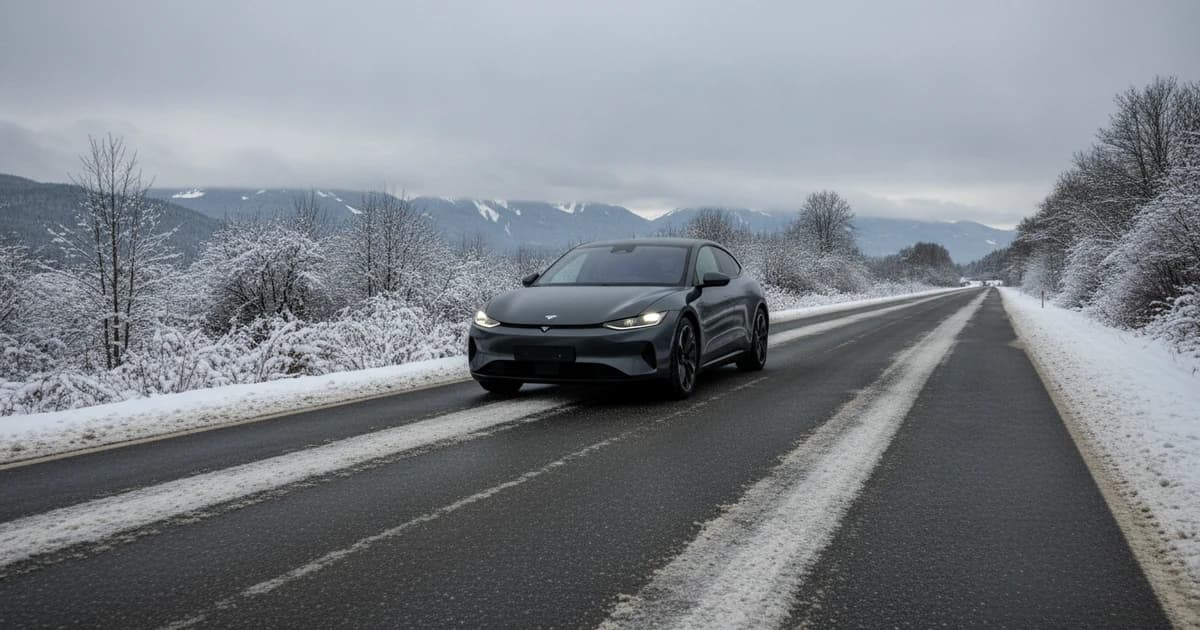
Exam-wise today: Switzerland has no general winter-tyre obligation by fixed date. Vehicles must be roadworthy and adapted to road and weather conditions (SVG framing Art. 29). In snow, ice or slush, winter-capable tyres are therefore practically expected – without a calendar alone deciding.
- No calendar duty: No “from date X winter tyres mandatory” as often assumed from AT/DE. CH = situation-based: adapted tyres.
- Tread depth: Observe the statutory minimum; for winter use there are often stricter recommendations (ASTRA) – see tread section.
- Snow chains: When needed or ordered (e.g. by the relevant signal) – described in words.
- All-season tyres: Can pass the check – but “always OK” is a typical trap; conditions count.
- Right-hand traffic (RHT): All examples assume Swiss right-hand traffic – no left-hand-traffic framing.
Rules hub: Swiss traffic rules. Speed, distance and visibility in winter are soft-bridged below – without rewriting the speed, safety-distance or fog-light posts.
Note: Framing follows typical syllabus / VRV / SVG / VTS logic and ASTRA recommendations. Not legal advice and not a substitute for official guidance – if in doubt, ask the road traffic office.
Winter vs summer vs all-season tyres
The exam core for Swiss winter tyres is not “Which tyre marketing do I like?”, but: Do the tyres match snow, ice, slush and winter slipperiness? This deep-dive owns situational winter equipment: when winter tyres are sensible/expected, what all-season can do – and why summer tyres in winter are a classic exam trap.
When winter tyres are sensible / expected
- Snow, ice, slush: The classic case – grip and lateral control need winter-capable tread and compound.
- Winter conditions: Even without fresh snow: wet-cold, ice, mountain passes – drive with winter-capable tyres as needed.
- Rule of thumb (recommendation): ASTRA often cites “O to O – October to Easter” as a practice rule of thumb – that is a recommendation, not a statutory calendar duty.
- Read the situation: Not “the calendar says winter”, but “road and weather require adapted tyres”.
Remember the triad: conditions → adapted tyres → adapt speed and distance. Winter tyres replace neither braking distance nor overview.
All-season tyres (M+S / snowflake) — exam-wise
- All-season / all-weather: A compromise – can help in mild winters and mixed conditions, but are not a free pass for every snow situation.
- Markings: M+S and/or snowflake / Alpine symbol appear in theory; exam-wise what counts is whether the tyre meets the conditions – not only the logo.
- No marketing claims: We rank no brands and sell no tyres – only exam logic: situation before label.
Trap: “All-season = always allowed / always enough.” Wrong when conditions clearly require winter-capable tyres and the tyre cannot cope. Read the situation, not only the sidewall.
Summer tyres in winter — typical exam trap
- Summer tyres on snow/ice: Exam-wise often unsuitable – grip lacks; braking and lateral control suffer.
- “Dry motorway, so summer OK?” – Situationally dry pavement can differ; as soon as snow, ice or slush arrives, adapted tyres count. Exams often show exactly that change.
- Liability / exam logic: Unadapted tyres can exam-wise be read as a breach of roadworthiness – the exam rewards the situation, not a CHF table.
Tread depth and tyre profile in Switzerland
For Swiss winter-tyre tread depth and tyre profile Switzerland, the exam often separates the statutory minimum from the safety recommendation. Stay precise – and do not import DE/AT figures as Swiss duty.
Minimum tread / exam mnemonic
- Statutory minimum (VTS framing): Pneumatic tyres must have at least 1.6 mm deep tread grooves across the whole tread surface (VTS Art. 58 para. 4 framing). That applies in principle to winter and summer tyres.
- ASTRA winter recommendation: For winter-capable tyres ASTRA often recommends at least 4 mm – because grip in snow and slush fades earlier than the statutory minimum. That is a recommendation, not an extra calendar duty.
- Summer recommendation (context): For summer tyres ASTRA often cites about 3 mm as a practice recommendation – here only for contrast; focus stays on winter.
Exam mnemonic: 1.6 mm = statutory floor; ~4 mm = common winter safety recommendation. Claiming “4 mm statutory winter-tyre duty” mixes recommendation and law – stay with the VTS minimum plus situational adaptation.
Why worn tread appears in the exam
- Picture questions: Worn tread, smooth surface, snow on the road – “may I continue?” → situationally no / fit adapted tyres.
- Measurement logic: Tread across the whole surface, not only “nice” in one spot.
- Safety before label: Even a “winter tyre” with too little tread exam-wise does not deliver what conditions require.
Note: Not a tyre-buying guide and no brand comparisons. Syllabus / VTS / ASTRA framing – if in doubt, road traffic office or official ASTRA info.
Snow chains Switzerland
For snow chains Switzerland and when they are mandatory: there is no general duty to carry chains all year. What matters is when they are needed or ordered – and how you then behave.
When to fit (conditions / order)
- Signal / order: Where snow chains are mandatory (relevant signal or order), fit chains on the driven wheels – typically at least two driven wheels on the same axle (exam-style SSV framing).
- Conditions: Even without a signal, heavy snow can situationally require chains so the vehicle can move and stay controllable – always within roadworthiness.
- In words, not as a picture substitute: We describe the duty situation in words – the rule is in the situation, not in an extra drawn sign.
- End of the duty: As soon as the order ends or conditions allow, remove chains – and adapt speed to the road again.
Optional short bridge on sign systematics in words: Swiss traffic signs – this post owns winter-tyre / chain logic, not the full sign catalogue.
Speed and behaviour with chains
- Slower: With chains a clearly reduced speed often applies – exam-wise: calm, not “drive the limit because the sign says 80”.
- Predictable: No risky overtakes “because I have chains”. Chains replace neither distance nor overview.
- Soft bridge speed: Limits and adapted speed: Swiss speed limits.
Speed, distance and visibility in winter
Winter pictures are often speed, distance and visibility pictures: ice, short sight lines, queues. Three soft bridges – without rewriting the other posts:
- Speed: Adapt speed to snow, ice and visibility – not “drive the limit because of the sign”. Details: Swiss speed limits.
- Distance: More safety distance on ice and wet/cold roads. More: Safety distance Switzerland.
- Visibility / lights: In fog, blowing snow or strongly restricted visibility, situational lighting counts – soft bridge: Fog lights Switzerland (this post owns tyres/chains, not the rear fog lamp).
Behaviour: calm, predictable, no risky manoeuvres “because winter tyres are on”. On the motorway in crawling traffic the Swiss emergency corridor (Rettungsgasse) can briefly matter (one sentence; this post is not rewritten into that topic).
If you practise in winter with a learner permit, allow extra time and distance – and know the drink-driving limit in Switzerland for learner drives too.
Exam-wise tyres often hang together with speed and distance: whoever “drives the limit” on ice while also having unadapted tyres shows exactly the restless pattern situational questions punish. Read tyres, speed and distance as one package.
Typical theory-exam traps
No copyrighted exam dumps – only exam-style rule explanations for Swiss winter tyres. Use the list as a training check.
- “From 1 November / until Easter winter-tyre duty like AT/DE?” – Not as Swiss calendar law. CH: adapted tyres / roadworthiness (SVG framing) – O–O rule of thumb is a recommendation, not a duty.
- “All-season = always enough?” – Trap. Conditions count; all-season can be a compromise but do not replace every snow situation.
- “Summer tyres in winter OK as long as tread is 1.6 mm?” – The tread floor alone does not make summer tyres winter-capable on snow/ice. Read the situation.
- “Forget snow chains although ordered / needed?” – Wrong. When mandatory or when conditions require chains: fit them and adapt speed.
- “4 mm is the statutory winter minimum tread?” – Mix-up. 1.6 mm = statutory minimum (VTS); ~4 mm = common ASTRA recommendation for winter tyres.
- “Unadapted tyres – does ‘I didn’t notice’ count?” – In exam logic, correct situation-based tyres count. Excuses do not replace the rule; the exam rewards the situation, not a CHF table.
How to practise winter-tyre & vehicle questions online for free
Many errors happen because “winter-tyre duty” is read as an AT/DE calendar instead of a Swiss situation picture. Goal when practising: stable pattern recognition – conditions? Adapted tyres? Tread? Chains needed? Speed & distance?
- Start with the demo and filter situation questions on vehicles and winter conditions.
- Practise mixed sets under learn the theory test online free.
- Move to full simulations via learn driving theory.
- Light upsell if needed: packages & prices.
Note: Organisational details can vary by canton. If in doubt, ask the competent road traffic office – this article does not replace official guidance.
FAQ
Is there a winter-tyre obligation in Switzerland?
Not as a rigid calendar duty. Situationally adapted, roadworthy tyres apply (SVG framing Art. 29). The “October to Easter” rule of thumb is a recommendation (ASTRA), not statute. Overview: Swiss traffic rules.
From when winter tyres in Switzerland?
No fixed date in Swiss law. As soon as snow, ice, slush or winter ice shape the conditions – and in practice often from autumn (O–O recommendation). The exam asks the situation, not the calendar.
What tread depth is needed?
Statutorily at least 1.6 mm tread grooves across the whole tread surface (VTS Art. 58 para. 4 framing). For winter tyres ASTRA often recommends about 4 mm – recommendation, not an extra calendar duty.
Are all-season tyres enough?
Situationally possible as a compromise – but not automatically “always OK”. In heavy snow/ice they can be insufficient; conditions count.
When are snow chains mandatory?
Where they are ordered as mandatory (signal/order) and situationally when conditions require them. No general year-round carry duty. Adapt speed with chains – bridge: Swiss speed limits.
May I drive with winter tyres in summer?
Exam-wise often not ideal (wear, handling in heat) – and tyres must suit the vehicle’s possible top speed (VTS framing on winter tyres/marking). This article’s focus stays winter use; for summer questions check the situation and permissibility, not marketing.
Ready to solve winter-tyre questions calmly?
Do not import AT/DE calendar duty as Swiss law, read the conditions, separate tread depth (1.6 mm minimum vs winter recommendation), fit snow chains when needed/ordered, adapt speed and distance – that is the exam core for Swiss winter tyres. Connect with Swiss traffic rules, speed limits, safety distance and fog lights, and practise situation pictures. Stable judgement under time pressure saves error points.
Practise free online · Start demo · Choose a package · Order