Fog lights Switzerland: when to switch on, rear fog lamp & theory
Swiss fog lights for the theory exam: when to switch on, rear fog lamp, dipped vs daytime lights and typical traps – clear and practise-ready.
Short answer — what are fog lights?
For fog lights in Switzerland, the theory exam mainly tests situational judgement: Do you recognise when visibility is considerably restricted by fog, blowing snow or heavy rain – and which lights you then need? This short answer is for skimming – the sections below cover when to switch on, front vs rear fog lamp, dipped/daytime lights and typical traps.
- When: Front fog lamps and the rear fog lamp may only be used when visibility is considerably restricted by fog, blowing snow or heavy rain (VRV framing Art. 30 para. 4). In clear visibility they stay off.
- Front vs rear: Front fog lamps (Nebellicht / Nebelscheinwerfer) help you see; the rear fog lamp (Nebelschlussleuchte) is a bright red light so following traffic can see you – and it dazzles more easily.
- Not fashion: No continuous use in good visibility, no “style lights”. Switch off as soon as visibility improves and others would be dazzled unnecessarily (SVG framing Art. 41: do not dazzle anyone unnecessarily).
- Daytime running lights are not enough: In fog you need dipped beam / appropriate lighting for the situation – daytime running lights alone often are not enough (often insufficient rear lighting).
- Right-hand traffic (RHT): All examples assume Swiss right-hand traffic – no left-hand-traffic framing.
Rules hub: Swiss traffic rules. Traffic lights (red/amber/green) belong in the soft-bridge article Traffic lights Switzerland – this post owns fog lamps / rear fog lamp, not the traffic light.
When must you switch on fog lights?
The exam core for when to switch on fog lights in Switzerland is not “Do I like these lights?”, but: Is visibility considerably restricted by fog, blowing snow or heavy rain? Then front fog lamps and the rear fog lamp may be used. In clear visibility or only light haze they stay off.
This deep-dive owns vehicle lighting in fog: when front/rear, boundary vs dipped and daytime lights, behaviour and exam traps. Traffic-light rules stay in the Lichtsignale article – here you train fog lighting.
Fog, heavy rain, strongly restricted visibility
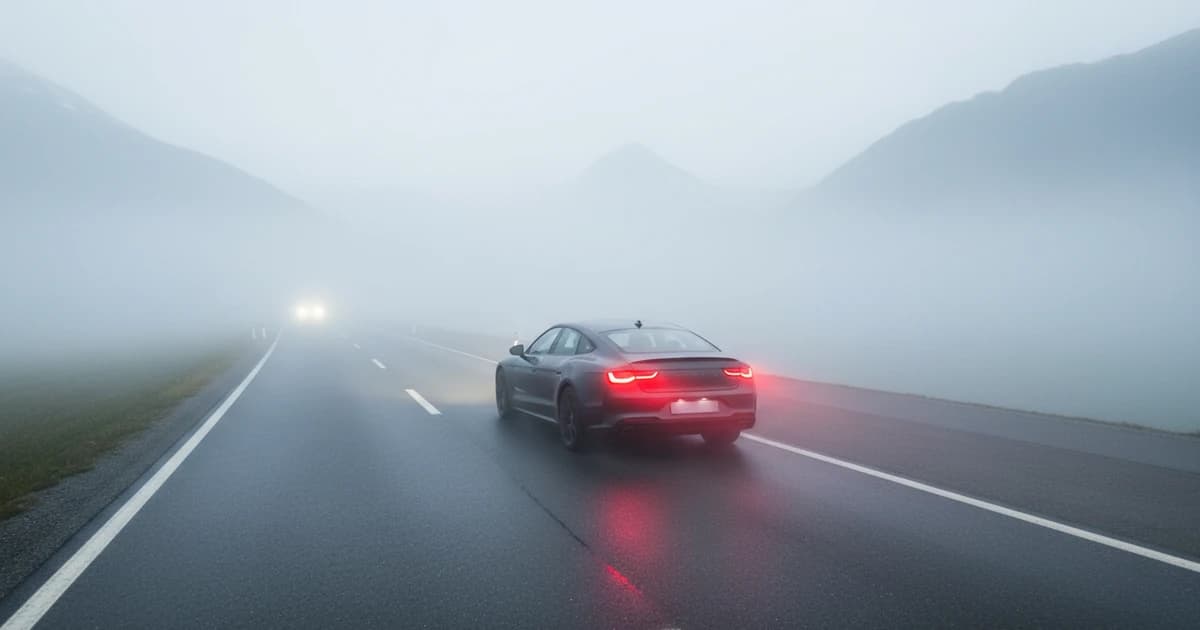
- Fog: The classic case – visibility clearly worse, contrasts missing, following and oncoming traffic need clear signals.
- Blowing snow: Same VRV framing as fog: considerably restricted visibility → fog lamps / rear fog lamp allowed.
- Heavy rain: Not every drizzle – exam-wise considerable loss of visibility counts, not “rain = always rear fog lamp”.
- Considerably restricted: The law states the threshold qualitatively (considerably), not as a fixed metre figure in the current VRV wording. Read the situation: can you still see the road, markings and other road users clearly?
Adapt speed and distance to visibility – bridges: Swiss speed limits and Safety distance Switzerland.
Visibility range as an exam mnemonic
In the current VRV framing for fog lamps / rear fog lamps there is no fixed metre figure as a statutory switch-on threshold. Exam teaching still often uses a soft mnemonic: older rule texts commonly taught about 50 m visibility for the rear fog lamp – roughly “two delineator posts”. Use that only as an exam-style mnemonic / formerly often taught, not as current hard statutory metres and not as imported German StVO.
- Current (legal logic): considerably restricted visibility due to fog, blowing snow or heavy rain → fog lamps / rear fog lamp allowed.
- Soft mnemonic: visibility very short (historically often ~50 m / two posts) → especially question and target the bright rear fog lamp.
- Switch off: as soon as visibility improves again or following traffic would be dazzled – see SVG logic below.
Note: Framing follows typical syllabus / VRV / SVG logic. Not legal advice and not a substitute for official guidance – if in doubt, ask the road traffic office.
Front fog lamps vs rear fog lamp
The most common mix-up for Swiss fog lights vs Nebelschlussleuchte: many say “fog light” for everything. Exam-wise you clearly separate front and rear.
Front (Nebelscheinwerfer) vs rear (red Nebelschlussleuchte)
- Front fog lamps (Nebellicht / Nebelscheinwerfer): Extra lamps low on the vehicle that should light the road ahead better in fog, blowing snow or heavy rain – without dazzling oncoming traffic like high beam in fog.
- Rear fog lamp (Nebelschlussleuchte): A bright red rear light so following traffic recognises you earlier. Clearly more intense than normal rear lights – that is why it dazzles more easily and has stricter “when to switch off again” logic.
Remember the picture: front = you want to see; rear = others should see you. Both only when visibility is considerably restricted – not a substitute for dipped beam on a clear night and not continuous lights in good weather.
When to switch the rear fog lamp off again
- Visibility improving: As soon as fog / blowing snow / rain eases and visibility is no longer considerably restricted → rear fog lamp off.
- Dazzling others: SVG framing Art. 41: handle lighting so nobody is dazzled unnecessarily. The rear fog lamp is especially dazzling – in a dense queue behind you or when you leave the fog, switch off early.
- Do not “forget”: Classic exam trap: rear fog lamp stays on although visibility is long clear. Exam-wise wrong and dangerous for following traffic in daily driving.
Short: the rear fog lamp is a tool for poor visibility – not a permanent accessory.
Lighting duty, dipped beam and daytime running lights — clear boundary
Short and clear – without rewriting the traffic light:
- Lighting duty / situational lighting: In darkness, tunnels and poor visibility you need appropriate vehicle lighting. Daytime running lights alone are often insufficient in fog – check and manually ensure rear lights and dipped beam as needed.
- Dipped beam: Standard in restricted visibility and darkness – do not replace it with high beam in fog (backscatter dazzles you and others).
- Daytime running lights: Meant for good daytime conditions; in fog / blowing snow / heavy rain they are exam-wise not enough alone.
- Fog lamps / rear fog lamp: Extra only when visibility is considerably restricted (VRV Art. 30 para. 4 framing) – not the same topic as traffic-light signals.
Traffic lights, amber phase and failed signals: soft bridge to Traffic lights Switzerland. Static signs in words: Swiss traffic signs. This article remains the owner of front fog lamps and the rear fog lamp.
Speed, distance and behaviour in fog
Fog pictures are often speed and distance pictures: short visibility, delayed reaction, queues. Two bridges – without rewriting the other posts:
- Speed: Adapt speed to visibility – not “drive the limit because the sign says 80”. Limits and defaults: Swiss speed limits.
- Distance: More safety distance in poor visibility and on wet/slippery roads. More: Safety distance Switzerland.
Behaviour: calm, predictable, no risky overtakes “because I have fog lights on”. On the motorway in dense fog the same lighting and visibility rules apply – and if traffic crawls, the Swiss emergency corridor (Rettungsgasse) can matter (one sentence; this post is not rewritten into that topic).
Typical theory-exam traps
No copyrighted exam dumps – only exam-style rule explanations for Swiss fog lights. Use the list as a training check.
- “Rear fog lamp already in light haze / clear visibility?” – No. Only when visibility is considerably restricted by fog, blowing snow or heavy rain. Off in clear visibility.
- “Leave the rear fog lamp on although visibility is good again?” – Wrong. Switch off as soon as visibility is enough or others would be dazzled (SVG anti-dazzle logic).
- “Daytime running lights enough in fog?” – Exam-wise often no. Ensure dipped beam / appropriate lighting for the situation – daytime running lights alone frequently do not cover rear/visibility needs.
- “Front fog lamp = rear fog lamp?” – Mix-up. Front fog lamps (see); bright red rear fog lamp (be seen) – different function and dazzle risk.
- “Rear fog lamp like hazard lights / fashion lights?” – No. Not a substitute for hazard lights and not continuous lights in good visibility.
- “Disregarding lighting rules – does ‘I didn’t notice’ count?” – In exam logic, correct situation-based lighting counts. Excuses do not replace the rule; we deliberately invent no CHF fine amounts here.
How to practise lighting & fog questions online for free
Many errors happen because “fog light” is read as a keyword instead of a situation picture. Goal when practising: stable pattern recognition – considerably restricted visibility? Front or rear? Daytime vs dipped? Rear fog lamp off again?
- Start with the demo and filter situation questions on lighting and poor visibility.
- Practise mixed sets under learn the theory test online free.
- Move to full simulations via learn driving theory.
- Light upsell if needed: packages & prices.
Note: Organisational details can vary by canton. If in doubt, ask the competent road traffic office – this article does not replace official guidance.
FAQ
When do I switch on fog lights?
When visibility is considerably restricted by fog, blowing snow or heavy rain (VRV Art. 30 para. 4 framing). In clear visibility front fog lamps and the rear fog lamp stay off. Overview: Swiss traffic rules.
What is the difference from the rear fog lamp?
Front fog lamps help you see. The rear fog lamp is at the back, bright red, and makes you visible to following traffic – it dazzles more easily and must be switched off sooner.
May I use the rear fog lamp in rain?
Only if the rain considerably restricts visibility – not in every light rain. As soon as visibility is enough again or others would be dazzled: switch off.
Are daytime running lights enough in fog?
Exam-wise usually no. Daytime running lights alone often do not cover the need in fog (incl. rear lighting). Ensure dipped beam / appropriate lighting; fog lamps / rear fog lamp only when visibility is considerably restricted.
Does this also apply in town / on the motorway?
The lighting logic (considerably restricted visibility; do not dazzle unnecessarily) applies in principle regardless of road type – in town as on the motorway. Adapt speed and distance to visibility; traffic-light rules stay at Traffic lights Switzerland.
Ready to solve fog & lighting questions calmly?
Switch on only when visibility is considerably restricted, separate front and rear, switch the rear fog lamp off early, do not overestimate daytime running lights in fog, and adapt speed/distance – that is the exam core for Swiss fog lights. Connect with Swiss traffic rules, traffic lights, speed limits and safety distance, and practise situation pictures. Stable judgement under time pressure saves error points.
Practise free online · Start demo · Choose a package · Order